
PART 3
“I like watching you work.”
No teasing.
I surprised myself with my answer.
“I like having you here.”
For years, I had kept the ranch and everything personal in separate boxes.
Sandra standing beside a cattle pen did not feel like an invasion.
She smiled.
“Good. Because I’m starving.”
“That I can fix.”
Friday night, I drove to Cox around nine while Sandra closed.
I waited outside while she locked the pumps and brought displays inside.
Then she sat beside me on the low concrete curb.
Traffic had thinned.
We watched headlights move along the highway.
“So,” she said.
“So?”
“Three years.”
I knew what she meant.
“Long time.”
“Why?”
I rested my forearms on my knees.
“My last relationship kept hitting the same wall.”
Sandra waited.
“I’d make plans. Ranch would change. Somebody called. An animal needed something. Equipment broke. I’d leave.”
“And she got angry.”
“Yeah.”
“Were you mad that she got angry?”
I looked at Sandra.
“Usually.”
“Was she wrong?”
That was why I liked talking to Sandra.
She didn’t automatically take my side because she wanted me to like her.
“No.”
I looked back toward the highway.
“I kept promising time I hadn’t protected. Then I acted like she was unreasonable for believing me.”
Sandra remained silent.
“After we broke up, being alone was easier. Nobody waiting on me. Nobody disappointed.”
“Safe.”
“Simple.”
“Not necessarily the same thing.”
“No.”
I rubbed my palms together.
“I didn’t stop dating because I was scared of women. Or rejection. I stopped because living by myself was easier than figuring out how to make room for somebody without resenting the effort.”
Sandra absorbed that.
Then she said, “When I asked you at the pump, I wasn’t trying to rattle you.”
“I know that now.”
“I’ve watched you for two years.”
“That sounds concerning.”
“You’re impatient.”
“Accurate.”
“You hate our coffee.”
“Objectively accurate.”
“You don’t suffer fools.”
“That depends on whether Kevin is listening.”
She smiled.
Then her expression became serious.
“Last winter, a delivery driver left a pallet where Dad couldn’t move it. You were already late getting back to the ranch, but you stayed in the sleet and helped him move every box.”
I remembered.
“Then Dad offered you coffee.”
“That wasn’t fair compensation.”
“You told him our coffee was punishment.”
“It was.”
She laughed softly.
Then she looked at me.
“I didn’t want to be the woman who only traded jokes with you across a counter anymore.”
I met her eyes.
“I’m glad you asked.”
“We call,” she said. “We don’t assume. We don’t disappear.”
“Agreed.”
“This weekend is the first time Dad has taken Friday through Sunday completely off. I’m running everything.”
“That’s big.”
“Tomorrow’s fuel delivery is mine.”
“I have three livestock trucks coming for fifty head tomorrow afternoon.”
Neither of us suggested cancelling our Saturday dinner.
That mattered.
She didn’t ask me to pretend the ranch was less important than it was.
I didn’t ask her to prove she liked me by abandoning the responsibility she had been trying to earn.
“We still on?” I asked.
“After the dust settles.”
“Seven.”
“Seven.”
Then Saturday tested every word we had said.
Rain started before dawn.
By noon, the ranch lanes were mud.
The livestock trucks were delayed nearly two hours because of an accident on the interstate.
By four-thirty, every schedule I had built was useless.
I called Sandra at 4:45.
“Trucks are late.”
“How late?”
“Could be an hour. Maybe more.”
“Do you need to move dinner?”
“Not yet. I’ll call again if I do.”
“Okay.”
No anger.
No guessing.
At 6:15, the last truck finally pulled away.
Kevin took the clipboard from my hand.
“Go.”
“I’m going.”
I showered fast, changed into clean clothes, and drove toward Cox.
I had spent the entire day solving problems I could not control.
Seven o’clock was still mine.
I pulled into the station exactly on time.
And found chaos.
A tanker truck sat diagonally across the lot, blocking several pumps.
Rain hammered the canopy.
The driver argued into his radio.
Inside, six customers waited at the register.
Sandra’s hair was coming loose from its clip. She was ringing up purchases while checking fuel-delivery paperwork.
Then she saw me.
Her face changed.
Seven o’clock.
I was there.
She wasn’t ready.
I stood near the entrance while she cleared the line.
When the final customer left, I walked to the counter.
“The tanker got delayed,” she said immediately. “His previous stop ran long. He got here twenty minutes ago. I have to stay through the drop and sign everything.”
I looked at the clock.
7:05.
“You knew he was delayed before twenty minutes ago.”
Sandra shifted.
Then I saw her reflex.
The same one I had seen hundreds of times.
She smiled.
“At least your clean shirt survived the rain.”
Anger came fast.
Not because she had to work.
I understood that better than almost anyone.
Because she had known.
And because instead of saying it plainly, she had tried to make it funny.
“Don’t.”
Her smile disappeared.
“Michael—”
“I’m not mad because the tanker is late.”
“I know.”
“No. I don’t think you do.”
My voice became harder.
“I moved my day to get here. You asked me not to disappear behind work. You knew the plan changed, and you didn’t call.”
“I thought I could get him unloaded before you arrived.”
“You guessed instead of telling me.”
“I was trying not to ruin the night.”
“And when I walked in, you joked.”
Her fingers tightened against the counter.
“Because I was embarrassed.”
I wanted to keep going.
That was the problem.

I could feel that old part of me looking for one final sentence strong enough to win.
I stepped backward.
“Do you know why this bothers me so much?”
Sandra didn’t answer.
“It feels exactly like why I stopped dating. I made room. Work changed everything. And I was the last person told.”
Her face softened.
“Michael, I’m sorry.”
“I’m too angry to decide anything else here.”
I lowered my voice.
“I’m leaving before I turn one bad night into something worse.”
That frightened both of us.
I could see it.
Neither of us knew whether I meant leaving the station or leaving whatever had started between us.
I walked outside.
Rain soaked my shoulders before I reached the truck.
I drove back to North Cove.
I didn’t speed.
I didn’t send an angry essay from the road.
When I got home, I sent one text.
Home safe. Hope the drop goes clean.
Then I put my phone down.
Sunday felt wrong.
I worked.
Checked fence lines.
Moved mineral bags.
Answered routine questions.
More than once, I left my phone in the truck on purpose.
Part of me wanted the old solution.
End it.
Clean.
Simple.
One bad experience had confirmed what I had believed for three years.
Relationships created expectations.
Work disappointed people.
People got angry.
Then I realized something.
That pattern had happened once with Sandra.
My response was already the same one I had used before.
Leave before it repeated.
Three years alone had not taught me how to build a relationship.
It had only allowed me to avoid practicing.
At four that afternoon, I was carrying mineral bags when I heard tires on gravel.
Sandra’s car stopped near the main house.
She got out wearing jeans and a gray sweater with no coat.
Wind whipped her hair across her face.
She walked toward me.
I put the bag down and met her halfway.
We stopped several feet apart.
“I wasn’t sure you’d want me here,” she said.
“I wasn’t sure either.”
“But I wasn’t letting last night be the last thing I said.”
I stayed quiet.
Sandra looked directly at me.
“I knew at five the tanker was delayed.”
That mattered.
No excuse first.
“I didn’t call.”
I waited.
“I told myself I could solve it. Get him unloaded and still make seven. I didn’t want to be the reason our plan failed.”
She took a breath.
“Then you walked in, and I knew I’d messed it up anyway. I joked because I was embarrassed.”
Wind rattled the metal siding behind us.
“You were right about the call,” she said. “I wasted your time. I’m sorry.”
“Did the delivery finish?”
“About nine.”
“Your dad?”
“Never had to come back.”
I nodded.
“Good. I know that mattered.”
Sandra did not give me a list of everything that had gone wrong as though difficulty erased responsibility.
She had driven fifteen miles to own the part that belonged to her.
Most of my anger was already gone.
“I accept the apology.”
She relaxed slightly.
“And I meant what I said.”
“I know.”
I looked at the ground.
“But I don’t like how I said it.”
Sandra frowned.
“I got cold because I wanted you to understand how angry I was. Not just hear it. Feel it.”
I looked back at her.
“I was trying to win.”
Her face softened.
“I’m sorry for that.”
For several seconds, neither of us spoke.
Then she said, “I didn’t come here so you’d tell me it didn’t matter.”
“It mattered.”
“Good.”
“But I still want this.”
I paused.
“If you do.”
Her shoulders dropped.
“I do.”
There it was.
No joke.
No phone screen.
No guessing.
A week earlier, Sandra had been the one willing to open the door.
I didn’t want her doing all the walking.
“Wednesday night?”
A small smile appeared.
“I’m free.”
“I’m taking you to dinner.”
“New date?”
“New date.”
“Who picks?”
“I do.”
“Deal.”
We still didn’t move.
“Sandra.”
Something in my tone made her eyes lift.
“Can I kiss you?”
She did not joke.
“Yes, Michael.”
I touched the side of her face.
Her skin was cold from the wind.
I leaned in slowly enough for her to meet me halfway.
One of her hands caught the front of my canvas jacket.
The other rested against my neck.
The kiss was warm, deliberate, and unhurried.
The night before, I had almost convinced myself that one ruined evening proved I had been right to stay single.
Standing there, I was grateful neither of us had allowed one bad night to make the whole decision.
When we separated, I rested my forehead against hers.
“Wednesday. Seven.”
“I’ll be ready.”
We both went back to work.
That was our life.
The ranch didn’t stop needing me because I fell for someone.
The station didn’t stop getting fuel deliveries because Sandra had a boyfriend.
The difference was that neither of us expected love to magically remove the inconvenient parts.
Wednesday, Tracy was working when I came to pick Sandra up.
She emerged from the stock room, looked at me, then at Sandra.
“I’m still waiting on the first-date report.”
Sandra grabbed her coat.
“He got the advance copy.”
Tracy studied me.
Understanding appeared.
“Ah.”
Then she turned around and disappeared into the stock room.
Sandra laughed.
By the following Saturday, Miller had the ranch evening check exactly when scheduled.
At Cox, Tracy took over the register before six.
Richard stayed home.
Nobody had been rescued from responsibility.
Sandra and I had simply stopped treating our time together as the first thing available for sacrifice.
A week later, I arrived at Cox at 5:30.
Not seven.
Sandra was wiping down the counter.
“You’re early.”
“We don’t have reservations until seven.”
“I didn’t come for the reservation.”
She walked around the counter.
“What did you come for?”
I had spent years keeping my life narrow because narrow was easy to control.
Sandra had never asked me to quit North Cove.
She had never asked me to become spontaneous or carefree.
She had asked me for something much more difficult.
Make room.
Keep my word.
Tell the truth when the plan changes.
I stepped closer.
“I don’t want to keep calling this a few dates.”
Sandra went still.
“I want you to be my girlfriend.”
A slow smile started.
“I want to plan around you as part of my life, not squeeze you into whatever is left after everything else.”
Her eyes became bright.
“And I’m asking because I want you. Not because you asked first.”
She stared at me for a long moment.
Then she said, “I asked to be your next date, Michael.”
“I remember.”
“But I never intended to be one date.”
Her voice grew quieter.
“I want this.”
Then she added, “I want you.”
I kissed her.
A minute later, Tracy came out, saw how close we were standing, and quietly turned around again.
Sandra laughed against my shoulder.
When her shift ended, we walked outside.
She climbed into the passenger side of my pickup.
“So,” she said. “Where are you taking your girlfriend?”
“I have a place.”
“Does it have coffee?”
“Not if they respect their customers.”
She shook her head.
“Drive, Walker.”
I did.
The months that followed were not perfect.
That was probably why they worked.
Winter arrived early along the Maine coast.
North Cove froze.
Cox became busier with heating-oil deliveries.
I still had a temper.
One morning, Miller left a gate unsecured.
I felt the old heat before he had finished explaining.
I told him to secure it.
Then I walked to the other end of the barn for ten minutes.
When I returned, I explained what could have happened without making him spend the rest of the morning being punished for a mistake he had already corrected.
Kevin watched the exchange.
Miller glanced toward him.
“That’s it?”
Kevin drank from his thermos.
“Apparently he’s learning.”
I heard them.
I ignored both.
Sandra changed too.
She took control of more delivery scheduling.
Richard finally began taking Tuesday mornings off.
The first time Sandra sent me a picture of him fishing from a small boat instead of standing behind the register, she wrote:
Progress.
Our most useful relationship rule came from the tanker disaster.
If work destroyed a plan, whoever cancelled had to call and suggest another time during the same conversation.
No vague “we’ll figure it out.”
No disappearing.
No joke pretending to be an apology.
It wasn’t romantic.
That was probably why it worked.
Before Thanksgiving, freezing rain forced me to move an evening livestock check.
I called Sandra before noon.
“I have to cancel tonight.”
“Okay.”
“Thursday, same time?”
“Thursday.”
Done.
Nobody guessed.
Nobody waited in a parking lot.
Nothing broke.
By spring, we had been together long enough that people stopped pretending not to know.
Kevin invited Sandra to ranch cookouts.
Richard started keeping coffee I could tolerate behind the counter, though he refused to admit it was for me.
Tracy regularly threatened to sell copies of Sandra’s original date report.
Sandra threatened violence against her phone.
I started spending one Sunday morning a month helping Richard with station maintenance.
Richard was the kind of man who could spend forty minutes explaining why a shelf bracket installed in 1997 should not be replaced because “there’s nothing wrong with it.”
I understood where Sandra got her stubbornness.
A year after our first date, Richard officially made Sandra general manager.
Two years later, he sold her a controlling interest in Cox Family Fuel & Market on terms that let him retire comfortably while keeping a small ownership share.
On his first official Tuesday as a retired man, he arrived at the station at 5:45 in the morning.
Sandra stared at him from behind the register.
“What are you doing here?”
“Getting coffee.”
“You have coffee at home.”
“Not station coffee.”
Sandra pointed toward me.
“He’s spent four years telling us it’s terrible.”
Richard looked at me.
“Man doesn’t know coffee.”
I lifted my cup.
“It has improved.”
Sandra narrowed her eyes.
“Traitor.”
Richard smiled.
Then he left.
That was the real victory.
He left because he wanted to.
Not because she forced him.
And he did not look back to make sure she knew what she was doing.
Three years after Sandra asked me out beside the gas pump, Kevin called me into the ranch office.
He was sixty-two by then.
He sat behind the desk and pushed a folder toward me.
“What’s this?”
“Open it.”
Inside was an offer to buy a minority stake in North Cove Ranch over several years and become operating partner.
I read the first page twice.
“You serious?”
“I’ve been serious for about two years.”
“Why now?”
“Because I’d like to spend part of my life somewhere besides this office before my knees stop working.”
I laughed.
Then stopped.
Years earlier, I would have answered immediately.
Work decision.
My decision.
Instead, I closed the folder.
“I need to talk to Sandra.”
Kevin smiled.
“That’s another reason I’m offering it to you.”
That night, Sandra and I sat at my kitchen table with the paperwork between us.
I showed her everything.
The debt.
The ownership percentage.
The income projections.
The additional responsibility.
The risk.
She read all of it.
“This is what you want?”
“I think so.”
“Think?”
“I want the ranch. I don’t know if I want every part of what owning it means.”
“Then we figure out that part.”
We did.
Together.
I accepted.
Not because Sandra gave permission.
Because my life was no longer a collection of decisions made alone.
That difference mattered to me more than the ownership papers.
Several years later, on a cold Tuesday afternoon, I pulled my faded blue pickup into Cox Family Fuel & Market.
Old snow lined the curb.
The station lights were already glowing against the gray Maine sky.
I had come from a meeting in Belfast, so I happened to be wearing a clean denim shirt.
The same type I had worn years earlier.
I stepped out and started fueling.
The glass door opened.
Sandra came outside in a thick wool coat.
Her breath showed white in the air.
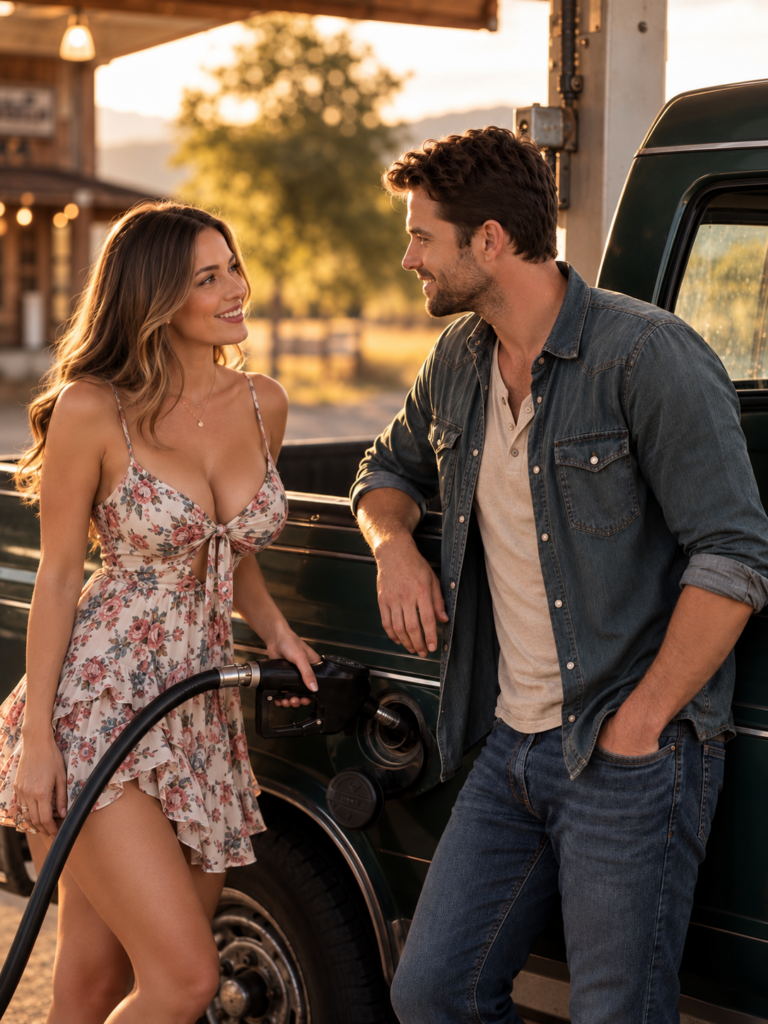
She walked over and leaned against the bed of my truck.
Exactly where she had stood the first time.
Her eyes traveled over the clean shirt.
Then my boots.
“Got a date?”
I locked the pump handle and turned toward her.
“Yeah.”
“Oh?”
I leaned against the truck beside her.
Our shoulders touched.
“Same woman.”
Sandra smiled.
“Lucky girl.”
“Debatable.”
“Who planned this one?”
I pulled my keys from my pocket.
“You did.”
I handed them to her.
“Your turn to pick the place. I’m passenger.”
Sandra took the keys.
“You’re trusting me with your truck?”
“Don’t make me regret it.”
She walked toward the driver’s side.
“Get in, Walker.”
I did.
She adjusted the seat and started the engine.
I looked across at her.
Years had passed since she asked a ranch manager who hadn’t dated in three years whether he wanted to try again.
She still ran Cox.
I still ran cattle.
Work still interrupted.
Weather still changed plans.
People still made mistakes.
We still argued.
The difference was that we had stopped confusing inconvenience with incompatibility.
That was what I had misunderstood for most of my adult life.
I thought a good relationship would be one that fit neatly into my existing life.
One that did not require much rearranging.
One that understood when work came first without asking me to explain.
What Sandra taught me was almost the opposite.
A relationship becomes real when you stop expecting another person to survive on whatever time remains.
It requires rearranging.
It requires calls you would rather not make.
It requires admitting when you screwed up before you start explaining why.
It requires hearing someone say, “You hurt me,” without treating the sentence like an accusation you have to defeat.
Most of all, it requires making room on purpose.
Sandra never asked me to choose between her and North Cove.
I never asked her to choose between me and the station.
We simply learned that important things deserve protected space.
Sometimes that meant seven o’clock dinner.
Sometimes ten minutes with terrible coffee.
Sometimes driving fifteen miles in a cold wind because the last conversation should not be the final one.
Sandra put the truck in gear.
The tires crunched over salt-stiff gravel.
“Where are we going?” I asked.
She looked at me.
“You said I’m choosing.”
“I did.”
“Then stop managing.”
I laughed.
“That’s a big request.”
“You’ll survive.”
She pulled us onto Route 1.
I looked back once at Cox Family Fuel & Market growing smaller behind us.
The same pumps.
The same highway.
The place where Sandra had looked at me years ago and asked a simple question I almost could have laughed away.
Going on a date?
At the time, I thought she was asking about Saturday night.
She wasn’t.
Not really.
She was asking whether I was willing to make room for someone again.
It took me longer to understand the question than it took me to answer it.
Sandra reached across the console and rested her hand over mine.
I turned my hand beneath hers and laced our fingers together.
The road stretched ahead through the cold Maine evening.
I still didn’t know where she was taking me.
For once, I didn’t need to.
It was her turn to choose.
And I was already there.
The End.

