
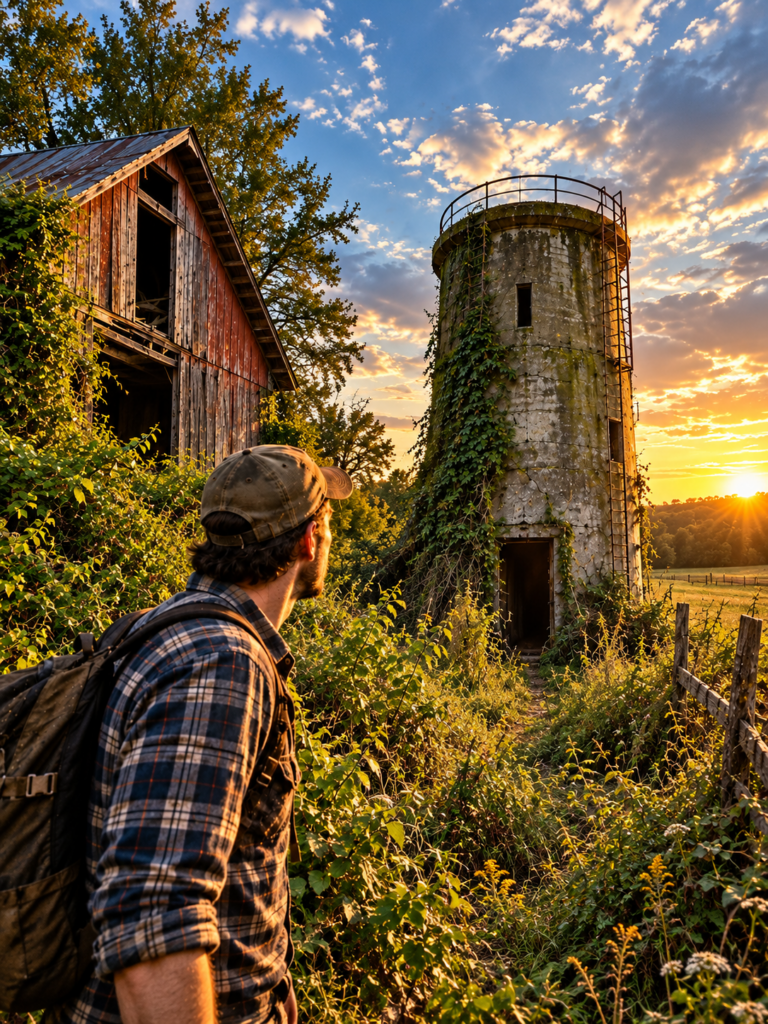
he found an abandoned concrete tower behind the barn — then learned why his family had hidden its real purpose for a century
Part 1
By the time Julian Cole bought the eight acres outside Luray, Virginia, nearly everyone else had decided the property was worthless.
The red barn leaned toward the east as though one more hard Shenandoah winter might finish it.
Half the fencing had disappeared beneath honeysuckle.
Wild grapevines climbed the old apple trees.
The farmhouse itself had burned sometime in the late 1970s, leaving only a stone foundation, a brick chimney, and waist-high weeds growing where a family kitchen had once stood.
The county had taken possession after decades of unpaid taxes.
At the foreclosure auction, only six people bothered to show up.
Three wanted timber rights.
One wanted the road frontage.
A local contractor looked at the barn, laughed, and told Julian, “You’ll spend more clearing it than the dirt’s worth.”
Julian bought everything for fourteen thousand dollars.
At thirty-two, he had been restoring old buildings for nearly eleven years.
He did not see abandoned properties the way other people did.
He noticed hand-cut beams.
Stone foundations.
Old hinges.
Roof pitches.
Drainage patterns.
He could walk into a collapsing house and usually tell within five minutes which walls were dying and which were simply ugly.
His father used to say he had inherited that from the Cole side of the family.
“Cole men can’t walk past a broken building,” Henry Cole once told him. “They have to find out why it’s still standing.”
Julian had rolled his eyes when he was younger.
Now Henry had been dead four years, and Julian found himself repeating the sentence whenever a client asked why he bothered saving structures that other contractors wanted to flatten.
The Shenandoah property was supposed to be different.
Not a client job.
Not another house repaired for someone wealthier.
His.
Julian intended to clear the land, save the barn if possible, and build a modest house overlooking the valley.
For the first time in his adult life, he wanted to restore something without handing the keys to somebody else.
On his third afternoon, he began cutting vines behind the barn.
The August heat lay heavily over the valley.
Cicadas screamed from the trees.
Sweat ran down Julian’s back beneath his work shirt as he attacked a wall of Virginia creeper with pruning shears.
He had been working for almost two hours when his blade struck something hard.
Concrete.
Julian stepped back.
“Hello.”
He pulled another vine.
Then another.
Gray surface appeared beneath the leaves.
At first he assumed it was part of an old retaining wall.
Then he walked ten feet to the right and realized the concrete continued upward.
Far upward.
Julian tilted his head.
Behind forty years of ivy stood a tower.
Nearly thirty feet tall.
Round.
Solid.
An iron ladder ran vertically up one side toward a narrow platform near the top.
Julian lowered the shears.
“How did nobody mention you?”
He walked around it slowly.
From the road, the barn hid the entire structure.
From the auction photographs, it had looked like little more than a dark mass behind vegetation.
Julian had assumed it was an old grain silo.
That was apparently what everyone else assumed too.
But the closer he got, the less sense that explanation made.
The walls were massive.
A normal farm silo did not require concrete this thick.
Julian tapped the surface.
Solid cast construction.
No poured block.
No obvious repairs.
He found the entrance beneath another curtain of ivy.
A narrow rectangular doorway.
Reinforced steel frame.
No agricultural building needed an entrance like that.
Julian crouched.
Old anchor bolts remained along the threshold.
Whatever door once occupied the frame had disappeared.
He looked toward the barn.
Then back at the tower.
His professional curiosity replaced exhaustion instantly.
He retrieved a flashlight from his truck.
Inside, the temperature dropped almost fifteen degrees.
The chamber was circular.
Dry.
No grain residue.
No feeding equipment.
No racks.
Nothing that suggested farm storage.
Instead, Julian’s flashlight caught brass.
A thick polished shaft rose vertically from the center of the concrete floor and disappeared through the ceiling.
Julian stepped closer.
“Okay.”
He swept the light toward the walls.
Heavy iron pulleys.
Steel cables.
Counterweights.
Some hung fifteen feet above him.
Others disappeared into narrow channels built directly into the concrete.
He turned.
A metal panel sat near the entrance.
Three circular gauges stared back through cloudy glass.
Julian wiped them.
PRESSURE.
ELEVATION.
AZIMUTH.
He frowned.
“Definitely not grain.”
Below the gauges, a small brass plate had nearly disappeared beneath oxidation.
Julian rubbed it carefully with his thumb.
Letters emerged.
PROPERTY OF SHENANDOAH OPTICS & TELEGRAPH CO.
MODEL 1922.
Julian read it twice.
He had restored railroad depots.
A nineteenth-century mill.
Two Civil War-era houses.
A 1911 schoolhouse.
He had never heard of the Shenandoah Optics & Telegraph Company.
He photographed the plate.
Then looked up.
Against the interior wall, narrow iron stairs curved upward.
They were not decorative.
They had been designed for regular use.
Julian tested the first tread with his boot.
Rust.
But solid.
He began climbing.
The spiral tightened near the top.
The air became hotter.
At the final landing, he pushed through a narrow opening and entered a small room beneath the tower roof.
Four window slits faced different directions across the valley.
Most were partially blocked by vines.
In front of the western opening stood a mechanism large enough to fill half the room.
Bronze shutters.
A pivoting mount.
Mirror brackets.
A heavy control lever.
Julian stared.
He walked to the window and pulled vines aside.
The view stopped him.
Blue Ridge Mountains rose in layered distance.
Fields stretched across the valley.
Far beyond them, another ridge caught late-afternoon sunlight.
From thirty feet up, the tower dominated everything around it.
Julian looked back at the bronze mechanism.
He understood before he knew the details.
This building had been made to see.
And to be seen.
He crouched beside the machinery.
A hand-painted marking remained on one gear housing.
STATION 4.
Julian traced the letters.
Then he noticed an iron handle connected to the central shaft.
He hesitated.
Any preservationist knew the rule.
Do not force old machinery.
But the handle moved slightly under his hand.
Not seized.
Julian pulled gently.
Nothing.
He increased pressure.
A counterweight shifted somewhere below.
Then—
clunk.
The mechanism moved.
Julian froze.
He pulled again.
Gears rotated overhead.
Steel cable tightened.
One bronze shutter opened a few inches.
After more than forty years of silence, the tower made a low mechanical hum.
Julian actually laughed.
“You’re still alive.”
He worked the handle slowly.
The shutter assembly rotated toward the western window.
A mirror mount rose.
Another gear engaged.
Then, from far below—
click.
Julian stopped.
That sound had not come from the machinery above.
It came from the ground floor.
He released the handle.
Everything settled.
Julian hurried down the iron stairs.
At the base of the central brass shaft, a square section of the concrete floor had opened half an inch.
He stared.
A hidden compartment.
Julian knelt and slipped his fingers beneath the edge.
The metal-lined panel lifted.
Inside sat a cylindrical tin container sealed around the lid with darkened beeswax.
Julian’s heartbeat quickened.
He removed it.
The container weighed perhaps three pounds.
He sat on the concrete floor.
For several seconds he simply held it.
He had learned enough from restoration work to distrust dramatic discoveries.
Most “hidden treasure” turned out to be old newspapers, mouse nests, liquor bottles, or somebody’s unpaid bills.
Still—
the beeswax seal was intact.
He carried the cylinder outside.
Sat in the shade of the barn.
And carefully peeled away the wax.
Inside were three objects.
A leather journal.
A rolled blueprint.
And two brass-rimmed optical lenses wrapped in felt.
Julian removed the journal first.
The leather was dry but remarkably preserved.
He opened the cover.
Handwriting filled the first page.
April 17, 1922.
Station Four commenced test operation at 6:20 a.m.
Visibility fair.
Signal received from Massanutten station at 6:41.
Julian turned another page.
Message logs.
Weather observations.
Coordinates.
Morse-code sequences.
Hundreds of entries.
Then he saw the name.
Operator:
Arthur Cole.
Julian stopped breathing for a moment.
Cole.
He read it again.
Arthur Nathaniel Cole.
A memory surfaced.
His grandfather mentioning an Uncle Arthur.
Not often.
Julian remembered only fragments.
Arthur had been “the strange one.”
An engineer maybe.
Or surveyor.
Someone who disappeared into the mountains.
Julian had never paid much attention.
He opened his phone and searched through an old photograph folder his mother had digitized after Henry died.
Family reunion.
Grandparents.
Birth certificates.
Then he found a photograph from roughly 1930.
Four men beside a truck.
His great-grandfather Samuel stood at one end.
Next to him—
a thin man with rolled shirtsleeves and wire spectacles.
The handwritten caption said:
Samuel, Arthur, Ben, Joseph.
Cole brothers.
Julian looked toward the concrete tower.
“No way.”
He opened the blueprint.
Eight circles had been drawn across a detailed map of the Shenandoah Valley.
Lines connected them.
Station 1.
Station 2.
Station 3.
Station 4.
And beside Station 4, in faded pencil:
Cole Farm Relay.
Julian sat absolutely still.
He had bought the property by accident.
At least that was what he had believed.
Now, with cicadas screaming around him and an old tower rising behind a collapsing barn, Julian realized the land had belonged to his own family a century earlier.
And no one had ever told him.
Part 2
Julian called his mother that evening.
Marianne Cole answered on the fourth ring.
“Please tell me you didn’t fall through another roof.”
“I found a tower.”
Silence.
“That is somehow worse.”
“Mom.”
“What kind of tower?”
“I don’t know exactly.”
He looked through the open barn doors toward the concrete silhouette.
“Optical telegraph. Weather station. Maybe emergency communication.”
“That sounds expensive.”
“That’s not the weird part.”
“With you, it never is.”
Julian smiled.
“Do you remember Grandpa mentioning Arthur Cole?”
His mother became quiet.
“Arthur?”
“Great-granduncle. Grandpa Samuel’s brother.”
“Yes.”
“What do you know about him?”
“Almost nothing.”
“Why?”
Marianne hesitated.
“Your grandfather didn’t like talking about that side of the family.”
Julian sat on his truck tailgate.
“What happened?”
“I thought this property was supposed to be relaxing.”
“Mom.”
She sighed.
“Arthur was an engineer, I think. Maybe worked for the railroad. There was some argument over land.”
“What land?”
“I don’t know.”
“You sure?”
“Julian, my father was born in 1940. Whatever happened was before him.”
“But he knew something.”
“All I remember is your grandfather saying the Cole family lost a farm during the Depression.”
Julian looked across the field.
“The one near Luray?”
Another silence.
“What?”
“I bought a farm near Luray.”
“You told me Shenandoah Valley.”
“This is Shenandoah Valley.”
“Julian.”
“There’s a blueprint in the tower. It labels this property Cole Farm Relay.”
His mother said nothing for several seconds.
Then:
“You need to talk to Aunt Margaret.”
Aunt Margaret Cole was ninety-one years old and lived in a retirement community outside Harrisonburg.
She was Julian’s grandfather’s youngest sister and the last living person in the family who remembered the older generation directly.
Julian visited two days later.
He brought photographs of the tower.
Margaret wore thick glasses and studied the first image for almost a minute.
Then she whispered:
“Well, I’ll be.”
“You recognize it?”
She looked at Julian.
“Your grandfather said it was gone.”
“The tower?”
“The farm.”
“It was.”
Margaret shook her head.
“No, I mean all of it.”
She placed the photograph on the table.
“My father hated talking about that place.”
“Why?”
“Because his father lost it.”
Julian sat across from her.
Margaret folded her hands.
“Our grandfather—your great-great-grandfather—bought that land around 1900. Small farm. Corn. Apples. Cattle. Nothing wealthy.”
“Arthur lived there?”
“Arthur and Samuel both did.”
Julian showed her the journal photograph.
Margaret smiled faintly.
“That’s Arthur’s writing.”
“You’ve seen it?”
“Christmas cards.”
She touched the picture.
“Arthur was different from the other boys. Always building things. Radios. Batteries. Mirrors. Your great-grandfather thought he was wasting time.”
Julian listened.
“In 1921,” Margaret continued, “some company came through looking for high ground. Telephone service in the valley was unreliable. Storms brought down lines constantly. Arthur convinced your great-grandfather to lease part of the farm for some kind of signal station.”
“The tower.”
“Yes.”
“What happened?”
Her expression changed.
“Flood.”
“What flood?”
“Nineteen thirty-six, maybe. Or thirty-seven. I don’t remember.”
She looked frustrated.
“My father said Arthur warned people before the river rose. Sent messages somehow.”
“Light signals?”
“Could be.”
Julian leaned forward.
“Then why did everyone stop talking about him?”
Margaret looked toward the window.
“Because Arthur left.”
“Where?”
“Nobody knew.”
“Why?”
“That part nobody explained to children.”
Julian waited.
Margaret finally said:
“Samuel blamed him for losing the farm.”
That evening Julian returned to Station Four with more questions than answers.
He spent the next week researching.
County archives.
Old newspapers.
Historical maps.
University collections.
The Shenandoah Optics & Telegraph Company appeared only briefly in surviving records.
Founded in 1921.
Private partnership.
Experimental network.
Eight mountaintop and valley stations.
Designed partly for weather observations and partly for emergency communications when telegraph and telephone wires failed.
Telephone infrastructure had expanded quickly afterward.
Radio improved.
The company disappeared by the late 1930s.
Julian found one newspaper reference from March 1936.
VALLEY SIGNAL CREWS WARN LOW FARMS OF FLASH FLOODING.
Another from 1928:
OPTICAL STATIONS AID SEARCH AFTER MOUNTAIN STORM.
The photographs were poor.
But one showed a concrete structure almost identical to his.
Julian took the journal to the Shenandoah Valley Historical Society.
Dr. Evelyn Brooks met him in the reading room.
She was sixty-three, with silver hair and the focused impatience of someone accustomed to people bringing her supposedly historic junk.
She opened the journal.
Her expression changed within minutes.
“Where did you find this?”
“Inside the tower.”
“What tower?”
Julian showed photographs.
Brooks stared.
“Where is this?”
“Behind my barn.”
She looked at him over her glasses.
“You have an intact station?”
“Mostly.”
“How intact?”
“The counterweight system still operates.”
She stood.
“Show me.”
The following morning Brooks arrived with two professors from a nearby university engineering department.
One specialized in communications history.
The other in mechanical systems.
Julian led them through the entrance.
Within ten minutes, professional restraint disappeared.
Professor Daniel Mercer stood beneath the brass shaft and whispered:
“This is extraordinary.”
Brooks examined the gauges.
“Do you understand how rare this is?”
“No.”
“Good,” she said. “Because if you did, you’d probably start touching things you shouldn’t.”
Julian smiled.
“I restore historic buildings.”
“Yes. Which means you’re exactly dangerous enough to be confident.”
They climbed the tower.
Mercer examined the shutter mechanism.
Professor Lisa Chen studied the counterweights.
“This entire aiming assembly is mechanical,” she said.
“No electric motor.”
Julian nodded.
“That’s what I thought.”
Chen traced a gear.
“Counterweights supply stored energy. Operator uses the handle to control azimuth and elevation.”
Mercer pointed toward the mirror mount.
“Arc lamp or heliographic mirror here.”
“What kind of range?”
“On a clear day?”
He looked through the western window.
“Twenty miles wouldn’t surprise me.”
Julian unfolded the blueprint.
Mercer’s eyes widened.
“Eight stations?”
“Apparently.”
Brooks said, “We have almost no physical documentation of the complete network.”
They spent hours comparing the journal to topographic maps.
By sunset, a forgotten system began reappearing.
Station One near Massanutten.
Station Two farther south.
Station Three above the river.
Julian’s Station Four.
Other sites toward higher ridges.
The operators used shutters to send coded pulses.
When storms destroyed wires, emergency messages moved across the valley as light.
One tower saw another.
Then another.
A message could travel miles without a cable.
Julian imagined it at night.
Mountain darkness.
Rain.
One light flashing from a ridge.
Another answering.
A mechanical language crossing farms and rivers.
Then Brooks found an entry from March 18, 1936.
Her finger stopped.
“Julian.”
He came closer.
Arthur Cole had written:
River rising beyond north marker.
Telephone line lost at 4:12.
Station Three reports bridge blocked.
Emergency flood warning relayed east at 4:19.
Five farms acknowledged.
Livestock movement begun.
Another entry an hour later:
Water entered lower Cole field.
Signal maintained.
Julian stared.
“My family’s farm flooded.”
Brooks turned pages.
At 7:03:
Barn compromised.
Father demands shutdown.
Refused.
Signal maintained for evacuation traffic.
At 8:41:
South counterweight jammed.
Manual operation continued.
Then:
Samuel says I chose strangers over family property.
He may be right.
But people below us were still in the water.
Julian felt something tighten in his chest.
Arthur had not caused the loss.
He had remained in the tower while his family’s farm flooded because he was sending warnings.
Julian understood immediately how resentment might grow afterward.
A damaged farm.
Debts.
A father grieving what he lost.
One son operating equipment for other people instead of saving livestock or tools.
History often became simple only after everyone who remembered the pain had died.
Julian kept reading.
The final entries ended in 1938.
Then nothing.
But tucked into the journal’s back cover was a folded piece of paper he had missed.
A letter.
Unsigned on the outside.
Inside:
Samuel,
I know you believe the tower took the farm from us.
It did not.
The bank did.
The water did.
Pride did more than either.
I could not stop the river.
I could send the warning.
I would do it again.
Arthur.
Below that, in different handwriting:
You always choose machines over blood.
Julian knew without being told.
Samuel.
His great-grandfather.
Two brothers.
Another silence.
Another family wound passed down until nobody remembered its shape.
Julian looked up through the narrow tower window.
He had purchased eight neglected acres because nobody else wanted them.
Now he knew his family had lost the same land almost ninety years earlier.
And at the center of that loss stood a structure everyone thought was worthless.
Part 3
The county inspector wanted the tower removed.
Not because he hated history.
Because he feared lawsuits.
“The balcony rail is failing.”
“I know.”
“Ladder’s corroded.”
“I know.”
“Spalling near the upper rim.”
“I’ve documented it.”
The inspector looked at Julian.
“You planning on arguing every point?”
“No.”
“You sound like you are.”
Julian folded his arms.
“I’m planning to repair it.”
The inspector laughed.
“For what?”
That question followed Julian everywhere.
For what?
The barn needed work.
He still had no house.
Money was limited.
The tower produced nothing.
Could not be rented.
Could not store enough grain to matter.
Could not become comfortable living space without destroying most of its historic equipment.
One contractor offered to demolish it for less than the cost of stabilizing the top platform.
“Concrete’s ugly anyway,” the man said.
Julian declined.
His mother was less direct.
“Are you sure this isn’t becoming an obsession?”
“Probably.”
“That wasn’t reassuring.”
“I’m a restorer.”
“You’re also trying to build a life.”
“This is part of it.”
“Julian.”
He knew what she meant.
Since his father’s death, Julian had worked almost constantly.
Henry Cole died from a heart attack at fifty-nine.
No warning.
No long illness.
One day he was helping Julian replace porch columns on a farmhouse.
The next morning he was gone.
Julian’s grief became work.
If he stayed busy enough, he did not have to think about unfinished conversations.
Henry had wanted him to buy property years earlier.
“Build something for yourself.”
Julian always answered:
“After the next project.”
There was always another project.
Then his father died before seeing him own anything.
The eight acres were supposed to correct that.
Now Julian was spending his savings restoring a century-old signal tower.
His mother worried he was turning grief into another excuse to postpone living.
Julian worried she might be right.
One evening he sat inside the barn while rain hammered the metal patches on its roof.
He had placed Arthur’s journal beside him.
The barn smelled of wet wood.
He opened to the flood entries again.
Arthur had remained on station despite losing his family’s lower fields.
Julian wondered what happened afterward.
Did Samuel forgive him?
No.
Apparently not.
Did Arthur regret staying?
The letter said no.
But people could be certain and heartbroken at the same time.
Julian turned pages more carefully.
Near the final entries he found repeated references to maintenance work.
Cable inspection.
Shutter adjustment.
Lens alignment.
Then a phrase:
Secondary archive prepared beneath Station Four.
Primary records transferred.
Julian stopped.
Secondary archive.
The floor compartment had contained only one journal, one blueprint, and lenses.
What was the primary archive?
He called Brooks.
She answered immediately.
“You found something.”
“How do you know?”
“You only call after nine when you found something.”
Julian read the line.
Brooks paused.
“Could refer to company records somewhere else.”
“Could refer to something inside the tower.”
“Don’t start breaking concrete.”
“I wasn’t going to.”
“Yes, you were.”
Julian looked toward the dark tower beyond the barn door.
“Maybe a little.”
The next day he and Professor Chen examined the machinery again.
The brass shaft did more than control the upper shutters.
Several cables disappeared beneath the floor.
They mapped each one.
One operated the hidden compartment.
Another appeared disconnected.
A third vanished through the tower wall toward the barn.
Julian stared.
“The barn?”
They traced the route externally.
Near the rear barn foundation, a narrow conduit emerged beneath stone.
The barn predated the tower.
Arthur and the company had incorporated it into the system.
Inside, Julian removed rotted floorboards along the back wall.
Beneath them lay an iron cable.
Still intact.
It ran toward the old tack room.
Julian followed.
At the base of one wall he found a cast-iron box covered by boards.
No handle.
Only a small slot.
Chen said, “Mechanical interlock?”
Julian thought of the tower control.
They returned to Station Four.
He pulled the primary lever through its full operating sequence.
Counterweights descended.
Shutters rotated.
Then, at the bottom of the movement, something resisted.
Julian applied gentle pressure.
Clunk.
From the barn came a metallic bang.
They ran.
The iron box had opened.
Inside was not treasure.
Not money.
Not gold.
It was better.
Photographic glass plates.
Dozens.
Wrapped in waxed paper.
Maintenance ledgers.
Personnel lists.
Weather records.
And a wooden case containing a portable signal lamp.
Brooks arrived before sunset.
She handled the records wearing gloves.
One photograph showed eight men standing beside Station Four in 1923.
Arthur Cole was among them.
Another showed farmers gathered around the tower after a storm.
Then Julian found one photograph labeled:
Flood relief, March 1936.
Arthur stood mud-covered beside his brother Samuel.
Together.
Julian stared.
If they were together after the flood, when had the family split?
The documents answered.
The farm did not disappear during the flood.
It survived.
Damaged, but operating.
What destroyed it came later.
Debt.
Repair costs.
A bad harvest.
Bank pressure.
By 1938 the family could no longer keep the property.
Samuel blamed Arthur partly because Arthur had invested his own savings in maintaining the signaling network instead of paying family debts.
But another ledger showed something Samuel apparently never knew.
Arthur had transferred nearly every dollar of his remaining company wages into the farm account.
Anonymous deposits.
Month after month.
“He was helping,” Julian whispered.
Brooks examined the numbers.
“He may have hidden it because his brother refused money from him.”
Julian found another envelope.
This one addressed to Samuel but never sent.
I cannot make you believe I chose the tower instead of you.
So I have stopped trying.
But every month I can spare something, I send it through Mr. Hale at the bank.
Do not ask him where it comes from.
Use it for seed.
Arthur.
Julian sat down on the barn floor.
The family story had hardened around betrayal.
Arthur chose machines over blood.
Samuel lost the farm.
Brothers stopped speaking.
Yet the records showed something more painful.
Arthur had continued helping.
Quietly.
Samuel may never have known.
Julian thought of his own father.
Henry had once offered to loan him money for a business.
Julian refused.
Pride.
He wanted to succeed alone.
Years later Henry suggested buying land together.
Julian postponed.
More pride disguised as independence.
Now he sat on land where the same disease had already cost his family decades.
That night Julian drove to his mother’s house.
Marianne opened the door.
“You look terrible.”
“Thanks.”
“What happened?”
“I need you to see something.”
He spread copies of the records across her kitchen table.
He explained the tower.
The flood.
Samuel.
Arthur.
The hidden deposits.
His mother listened quietly.
When he finished, she touched Arthur’s photograph.
“My father hated him.”
“Grandpa never met him.”
“I know.”
“That’s what I mean.”
Marianne looked up.
Julian continued.
“He inherited an anger that wasn’t even his.”
She sat back.
“So did your father.”
Julian frowned.
“What?”
“Henry knew there was old Cole land somewhere near Luray.”
“He knew?”
“Not exactly where.”
“Why didn’t he tell me?”
“He tried finding it when you were a child.”
Julian stared.
“Dad looked for this property?”
“Several times.”
“Why?”
Marianne smiled sadly.
“Because your grandfather once told him the Cole family had built something important there.”
Julian could barely speak.
“He never found the tower?”
“No.”
“He knew about Arthur?”
“Only stories.”
She looked at the photograph.
“Your father wanted to know whether any of it was true.”
Julian sat back.
His purchase had felt accidental.
A cheap property at an auction.
A collapsing barn.
A hidden tower.
But his father had spent years searching for the same place.
And Julian had found it only after Henry was gone.
That realization hurt more than he expected.
“He would’ve loved this.”
“Yes.”
“I should’ve bought land when he asked.”
Marianne reached across the table.
“Your father did not die angry with you.”
“I know.”
“Do you?”
Julian looked down.
She squeezed his hand.
“You don’t honor somebody by punishing yourself for surviving them.”
The sentence stayed with him during the drive home.
For the first time, Julian began to see the tower differently.
Not as a puzzle left by Arthur.
Not even as an engineering relic.
As an opportunity.
His family had spent nearly a century remembering the wrong story.
He could restore more than the concrete.
Part 4
The restoration began in September.
Julian set a strict budget.
Eight hundred dollars for materials he could not salvage or source through donations.
The historical society covered archival preservation separately.
Local businesses contributed supplies once newspapers began reporting on the discovery.
Julian refused offers to modernize the tower cosmetically.
“No fake antique fixtures.”
“No decorative gears.”
“No replacing original iron unless structurally necessary.”
He pressure-cleaned the concrete at low intensity to remove moss without damaging the surface.
Forty years of ivy came away.
The tower emerged pale gray beneath it.
Cracks were injected and sealed.
Corroded railing sections were reinforced.
Steel cables were cleaned and lubricated.
Brass components received gentle treatment rather than aggressive polishing.
Julian wanted visitors to see age.
Not pretend it had never existed.
The barn received emergency stabilization.
He replaced three failed beams using reclaimed oak.
Rebuilt part of the roof.
Preserved the iron cable connecting barn and tower.
Professor Chen spent weekends documenting the mechanical system.
She became slightly obsessed with the counterweights.
“You understand how elegant this is?”
She asked the question every visit.
“No electricity for movement.”
“Yes, Lisa.”
“Gravity does everything.”
“Yes.”
“People don’t appreciate gravity.”
“I appreciate it constantly when carrying lumber.”
She ignored him.
The restored mechanism revealed the tower’s full design.
Operators could aim the reflector by elevation and compass direction.
Counterweights balanced the heavy shutter assembly.
A mechanical timing wheel helped regulate Morse pulses.
Weather instruments recorded pressure and wind conditions.
During daylight, mirrors reflected sunlight.
At night, arc lamps provided signal.
During severe storms, operators could use backup chemical lamps.
Everything had redundancy.
Everything had been designed around the assumption that ordinary infrastructure would fail.
Julian admired Arthur more each week.
Not because he had been a genius.
Because he was practical.
Every elegant solution served a human problem.
When phone lines disappeared, people still needed warnings.
When bridges washed out, farmers needed information.
When weather moved across mountains faster than vehicles could travel, light could outrun both.
In October, Julian climbed the tower at sunset after everyone left.
Restoration was nearly finished.
The western shutter worked.
The brass shaft turned smoothly.
The balcony railing no longer moved under his hand.
He stepped outside.
The Shenandoah Valley stretched below him.
Autumn had begun coloring the ridges.
He imagined 1922.
No subdivisions.
Fewer paved roads.
Farmhouses separated by dark fields.
On distant peaks, small stations waited.
A signal flashed.
Then another.
Human beings throwing light across miles of darkness because somebody somewhere needed to know what was coming.
Julian understood why Arthur refused to shut down during the flood.
Then he imagined Samuel below, watching livestock disappear in rising water.
He understood him too.
That was the problem with family stories.
Everyone wanted one villain.
Reality rarely cooperated.
The historical society scheduled a public open house for November.
Three days beforehand, a storm warning appeared.
Heavy rain.
High winds.
Possible flash flooding.
Julian nearly laughed at the coincidence.
Then the rain became serious.
By Friday night, several roads across the valley had flooded.
Power failed in pockets.
Cell service weakened.
Julian stood inside the restored barn listening to weather radio.
His property sat safely above the river.
But lower farms did not.
At 9:14 p.m., Marianne called.
“Are you all right?”
“Fine.”
“You sound excited.”
“I’m not excited.”
“You absolutely are.”
Julian looked toward the tower.
“I’m thinking.”
“That’s usually worse.”
A volunteer firefighter stopped by.
“County’s trying to reach the Henderson farm across the eastern ridge.”
“Phones down?”
“Spotty.”
Julian knew the property.
Older couple.
Cattle.
Low crossing that flooded quickly.
The firefighter looked at the tower.
“You’re not thinking what I think you’re thinking.”
Julian smiled.
“Depends.”
“You got another station to receive anything?”
“No.”
“Then no.”
Julian agreed.
The tower was history, not magic.
The original network no longer existed.
But the moment reminded him why it mattered.
These structures had not been curiosities.
They had been emergency infrastructure.
The next morning floodwaters receded without major loss.
The Hendersons were safe.
Still, the storm changed Julian’s plans for the opening.
He did not want visitors seeing gears merely because gears were beautiful.
He wanted them to understand why someone built the tower.
At the open house, more than two hundred people arrived.
Children climbed the interior stairs in small groups.
Retired engineers stared at the pulley system.
Farm families examined copies of the 1936 flood records.
A ninety-four-year-old man named Warren Hale stood before Arthur’s photograph for several minutes.
Julian approached.
“You knew him?”
“My father did.”
Julian’s heart jumped.
“Arthur Cole?”
Warren nodded.
“My father worked at the bank in town.”
“Hale?”
The old man looked surprised.
“How’d you know?”
Julian led him to a copy of Arthur’s letter.
Mr. Hale at the bank.
Warren read it.
His eyes filled.
“My father told me something about this.”
“What?”
Warren sat.
“When I was a boy, your great-granduncle came to our house sometimes.”
Julian waited.
“My father said Arthur had a brother too stubborn to accept help.”
“That sounds familiar.”
Warren smiled.
“Arthur would hand Dad cash. Dad put it against farm debts anonymously.”
Julian swallowed.
“So Samuel really never knew?”
“I don’t believe so.”
“Why didn’t your father tell him later?”
“Bank confidentiality.”
“Even after Arthur left?”
Warren shrugged.
“Different generation.”
Julian almost laughed at the phrase.
Different generation.
So many silences excused by it.
“Do you know where Arthur went?”
Warren thought.
“West, I believe.”
“Anything more?”
“My father received a Christmas card from Colorado once.”
That night Julian searched genealogical records.
He eventually found Arthur Cole in Colorado in the 1940 census.
Civil engineer.
Later records placed him in Oregon.
No children.
Never married.
He died in 1971.
Julian stared at the screen.
Arthur lived another three decades.
Samuel lived until 1964.
Two brothers were alive at the same time for more than twenty-five years.
No evidence suggested they ever reconciled.
Julian closed the laptop.
The next morning he drove to Harrisonburg and visited Aunt Margaret again.
He told her everything.
She listened.
Then whispered:
“My father was wrong about Arthur.”
“He only knew Samuel’s version.”
“That doesn’t make it less wrong.”
“No.”
Margaret stared at the photographs.
“Do you know what bothers me?”
“What?”
“All those years, we said Arthur abandoned everybody.”
Julian nodded.
“He didn’t.”
“No.”
She touched the photograph of Arthur and Samuel after the flood.
“He was helping them the entire time.”
Margaret began crying.
Julian sat beside her.
The tears were not merely for Arthur.
They were for the terrifying ease with which families could inherit resentment more faithfully than truth.
Before Julian left, Margaret held his wrist.
“Put their names together.”
“Where?”
“At the tower.”
He understood.
“Arthur built it.”
“Yes.”
“And Samuel?”
Margaret looked at him.
“Samuel kept the farm going underneath it.”
Julian nodded.
No hero.
No villain.
Two brothers.
Both tired.
Both proud.
Both losing things they loved.
He decided the restored site would tell all of it.
Part 5
The state historic review took months.
Engineers inspected the tower.
Historians verified the journal.
The university documented the mechanism.
The surviving blueprint became one of the most important records of the forgotten Shenandoah optical network.
Several other station locations were eventually identified.
Most were gone.
One had been demolished for a road.
Another existed only as foundation stones.
One mountaintop station had collapsed decades earlier.
Station Four was the only structure found substantially intact.
By spring, the designation became official.
Not simply as the Cole Optical Signaling Tower.
Julian chose a longer name.
THE ARTHUR AND SAMUEL COLE SIGNAL STATION.
Dr. Brooks asked why.
“Arthur was the operator.”
“I know.”
“Samuel didn’t design it.”
“No.”
“Then why include him?”
Julian looked toward the barn.
“Because history already spent eighty years choosing between them.”
Brooks smiled.
“Fair enough.”
The brass plaque beside the entrance contained no dramatic claim.
Built 1922.
Operated as Station Four of the Shenandoah Optics & Telegraph emergency communication network.
Restored 2026.
Beneath it:
During storms and communications failures, this station transmitted optical warnings across the valley.
Arthur Cole served as its primary operator.
The surrounding farm was maintained by his brother Samuel Cole and their family.
Their story reminds us that history is rarely preserved whole unless someone chooses to listen to every side.
Julian added one final sentence.
Sometimes the structures we call useless are simply waiting for someone to remember what they protected.
The tower became the centerpiece of his homestead.
But he never turned it into a commercial attraction.
Small school groups visited.
Engineering students studied the counterweight system.
Local historians held occasional tours.
Admission was free.
A donation box near the barn helped pay for maintenance.
Julian converted the upper room into a quiet design studio.
He installed a simple desk that did not interfere with the historic equipment.
From thirty feet above the field, he could sketch restoration projects while looking across the same ridges Arthur had watched a century earlier.
The optical lenses remained.
The gears remained.
The brass shaft remained.
Even the hidden floor compartment remained functional.
Julian sometimes demonstrated it for children.
He would pull the control.
Gears turned.
Counterweights moved.
Then—
click.
The floor panel opened.
Children always gasped.
“What was inside?”
One would ask.
Julian would show copies of the journal.
“This.”
Some looked disappointed.
“No treasure?”
Julian smiled.
“This is treasure.”
One boy once asked:
“How much is it worth?”
Julian thought of Arthur.
Samuel.
The farm.
His father searching for the land and never finding it.
His family carrying an incomplete story for generations.
“I don’t know.”
The boy frowned.
“But old stuff has prices.”
“Some does.”
“What about this?”
Julian looked around the tower.
“This gave people warnings when floods came.”
“So?”
“So how much is a warning worth if it saves your farm?”
The boy thought.
Julian continued:
“How much is a message worth if someone you love is stranded twenty miles away?”
The child had no answer.
Neither did Julian.
That summer, he finally began building his house.
Nothing large.
Two bedrooms.
Wide porch.
Stone fireplace.
Timber framing.
He positioned it where the tower remained visible from the kitchen window.
Marianne visited during construction.
She stood on the unfinished porch.
“Your father would’ve complained.”
Julian laughed.
“About what?”
“The roof pitch.”
“It’s correct.”
“He would have found something.”
“That’s true.”
She looked toward the tower.
“He really wanted you to have land.”
“I know.”
“He’d be happy.”
Julian tightened a bolt on the porch post.
“I wish he’d seen it.”
Marianne waited.
Julian continued.
“I keep thinking if I’d bought something earlier…”
“No.”
“Mom—”
“No.”
She stepped closer.
“You are doing exactly what Samuel and Arthur did.”
Julian frowned.
“What?”
“Turning regret into a job you can work on forever.”
That silenced him.
Marianne pointed toward the tower.
“You restored it.”
“Yes.”
“You found the truth.”
“Yes.”
“You built the house.”
“Almost.”
“Then live here.”
Julian looked at her.
“Stop acting like suffering longer proves you loved your father more.”
The words landed hard.
He looked down.
After a moment he said:
“You save that line for twenty years?”
“I’m your mother. I have inventory.”
Julian laughed.
Then hugged her.
That autumn, he moved into the house.
For the first time since Henry’s death, Julian had days when he did not work until dark.
He sat on the porch.
Watched storms roll across the Blue Ridge.
Cooked dinner.
Invited neighbors over.
The restored barn became a workshop.
The tower became a study.
And the property became what it had once been before debt, floods, pride, and time stripped it away.
A home.
Aunt Margaret came in October.
At ninety-two, climbing the tower was impossible.
So Julian set up a chair outside.
She looked upward.
Vines were gone.
Concrete cleaned.
Railing straight.
Autumn sunlight caught the narrow observation windows.
Margaret smiled.
“My father would not believe this.”
Julian sat beside her.
“Would Samuel?”
She considered.
“Samuel probably would complain that you spent too much money.”
Julian laughed.
“What about Arthur?”
Margaret looked at the tower.
“Arthur would climb up and start adjusting things.”
They sat quietly.
After a while Margaret said:
“You know, when I was little, I thought family history meant knowing everybody’s names.”
“What do you think now?”
“Knowing what they misunderstood.”
Julian looked at her.
“That sounds depressing.”
“It can be.”
She smiled.
“But sometimes you get a chance to correct it.”
The following year, Julian and Professor Chen completed a working demonstration reflector.
Not to replace the original.
To show visitors how the system operated.
Another volunteer team established a temporary receiving station on a ridge several miles away.
On October 17, shortly after sunset, a crowd gathered around Station Four.
Children.
Farmers.
Historians.
Students.
Julian stood in the upper room.
He positioned the reflector.
The original gears moved beneath his hand.
Slowly.
Smoothly.
Just as they had when he first discovered them.
Chen called from below using a radio.
“Receiving station ready.”
Julian switched on the modern safe lamp mounted behind the reproduction shutter.
He transmitted three Morse-code letters.
C.
O.
L.
Pause.
Then:
E.
On the distant ridge, a light answered.
The crowd below cheered.
Julian did not.
He stood at the narrow window watching that faraway light flash.
For a moment the valley changed.
Modern houses disappeared in the darkness.
Road noise faded.
He imagined Arthur standing in the same room.
Storm wind against concrete.
Telephone wires down.
One hand on the lever.
A farmer somewhere below waiting for news.
A light answering from another mountain.
Julian rested his hand on the original brass shaft.
“Got your message,” he whispered.
He knew Arthur could not hear.
That was not the point.
Later, after everyone left, Julian remained in the tower.
A storm had passed earlier in the week, leaving the night unusually clear.
Stars filled the sky.
Lights from farms dotted the valley floor.
The barn below looked small.
His new house glowed warmly beyond it.
Julian opened Arthur’s journal.
He no longer stored the original in the tower—the historical society kept it climate controlled—but he had made a full reproduction.
He turned to the flood entry.
Samuel says I chose strangers over family property.
He may be right.
But people below us were still in the water.
Julian read the unsent letter again.
I could not stop the river.
I could send the warning.
I would do it again.
For decades, those words had been hidden beneath concrete.
So had the evidence of Arthur’s monthly payments.
One brother believed he had been abandoned.
The other believed explanation was useless.
Their silence outlived both of them.
Julian understood something then that he had missed earlier.
The tower’s original purpose was not simply communication.
Its purpose was overcoming distance.
Mountains.
Broken wires.
Storms.
Floodwater.
When ordinary paths failed, the tower created another way for one human being to reach another.
That was what made the Cole family story so painful.
Arthur could send a message twenty miles across a storm-dark valley.
But he and Samuel could not cross the distance between two stubborn brothers.
Julian closed the journal.
The irony would have amused his father.
Henry always hated people who could fix complicated machinery but refused to repair simple relationships.
Julian stepped onto the balcony.
Below, the property that had been abandoned for four decades was alive again.
The barn stood straight.
The house lights were on.
Fresh fencing followed the field.
The old apple trees had been pruned.
Visitors would return Saturday.
A group of eighth graders wanted to see the counterweights.
A university class wanted to study the concrete.
A retired telegraph operator had offered to demonstrate Morse code.
None of that would have happened if Julian had listened to the people at the auction.
Worthless.
That was the word they used.
Worthless land.
Worthless barn.
Worthless concrete silo.
Fourteen thousand dollars.
Eight acres.
One collapsing structure.
One tower hidden beneath ivy.
Julian had thought he was buying a place to start over.
Instead he purchased the unfinished sentence of his own family history.
Over the years, people continued asking what the property was worth now.
Julian never gave them a number.
The land had appreciated.
The house had value.
Historic designation increased attention.
Someone once offered to buy everything for several times what Julian had invested.
He declined.
Not because the property could never be sold.
He was not sentimental enough to believe ownership itself created morality.
He declined because he was not finished living there.
That was different.
On the tenth anniversary of the tower’s restoration, Julian stood beside a group of students while an approaching summer storm darkened the mountains.
One girl pointed toward the brass mechanism.
“Mr. Cole, did your great-great-uncle know this thing would still be here a hundred years later?”
“Great-granduncle.”
She shrugged.
“Whatever.”
Julian smiled.
“Probably not.”
“Then why did they build it so strong?”
He looked at the concrete walls.
Three times thicker than anyone would have used for an ordinary farm structure.
Steel reinforcement.
Mechanical backups.
Heavy gears.
Everything designed to survive storms.
“Because they needed it to work when everything else stopped working.”
The girl looked toward the mountains.
Thunder rolled.
“So that’s why it looks like a bunker?”
“Pretty much.”
She nodded.
Then asked:
“What did it really do?”
Julian could have given the technical answer.
Optical signaling.
Weather observation.
Emergency telegraph relay.
Morse transmission.
Instead he looked across the valley.
“It told people what they needed to know before it was too late.”
The girl seemed satisfied.
Rain began striking the tower.
Students hurried toward the barn.
Julian remained for a moment.
Water darkened the concrete.
The structure did not move.
It had survived almost everything.
Flood.
Depression.
Abandonment.
Forty years of vines.
A family forgetting why it existed.
And now it stood visible again.
Not polished into something new.
Not converted into a luxury room.
Not stripped of the machinery that gave it meaning.
Restored.
Julian had learned there was a difference.
New things tried to erase what came before.
Restoration asked what could still be saved.
The same was true of land.
Of memory.
Of families.
He touched the brass plaque beside the entrance.
Arthur Cole.
Samuel Cole.
Two names finally written beside each other again.
Then Julian walked through the rain toward the barn.
Behind him, the old concrete tower rose over the property.
A structure the town had mistaken for a useless silo.
A machine the family had forgotten.
A monument built not for war or wealth, but for the simple human need to send a warning across darkness and know somebody on the other side had received it.
And after nearly a century of silence, the message had finally arrived.

