
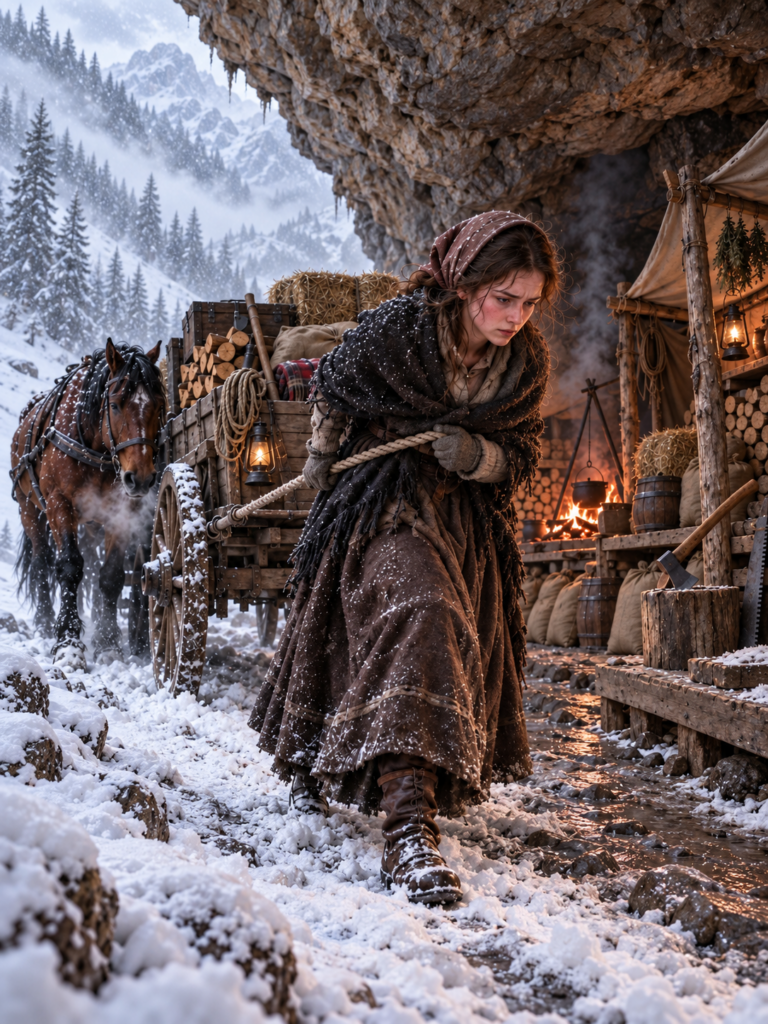
thrown out at 18, she dragged a broken wagon into a mountain cave — then the great freeze came, and the uncle who stole her home never expected her to return
Part 1
Before sunrise on November 1, 1891, eighteen-year-old Evelyn Hart stood behind the only home she had ever known and pulled a rope tight across an old freight wagon.
Frost covered the boards beneath her boots. The mountains above Silverton, Colorado, were hidden behind a wall of gray cloud, and the cold had the sharp, metallic bite that told every rancher and miner in the valley that winter had arrived early.
Behind Evelyn, the kitchen lamp glowed through the window.
She had lit that lamp every morning for almost two years.
Now it belonged to her uncle.
Silas Hart stepped onto the back porch and folded his arms inside his heavy wool coat.
“You’ve got forty minutes left.”
Evelyn did not answer.
“Did you hear me?”
“I heard you.”
Silas shifted impatiently.
“Then quit standing there.”
Evelyn looked at the wagon.
One rear wheel leaned slightly outward. Her father had repaired it twice before his death, and Evelyn had repaired it once more during summer. It might last ten miles. It might break before she reached the end of the road.
But it was all she had.
Her father, Thomas Hart, had died two winters earlier after a fever that began as a cough and ended with Evelyn sitting beside his bed, holding his hand while a February storm shook the windows.
Her mother had lasted until spring.
After that, Evelyn had run the property alone.
She planted potatoes.
She mended fencing.
She chopped wood.
She patched the roof over the shed.
She learned which merchants in Silverton would extend credit and which ones smiled while quietly increasing the price because they knew an eighteen-year-old girl had no man standing beside her.
Then Uncle Silas came.
He arrived in July with his wife, Martha, and their two sons.
At first, Evelyn had nearly cried with relief.
Silas told her family belonged together.
He fixed one section of fencing and helped bring in firewood. Martha took over the kitchen. The boys slept in the room that had once belonged to Evelyn’s older brother, who had died as a child.
Then Silas began making decisions.
He sold one of her father’s plows.
He told a merchant to put the Hart account in his name.
He moved papers from her mother’s desk into a locked drawer.
Whenever Evelyn objected, he called her ungrateful.
“You can’t run a property by yourself,” he told her.
“I have been.”
“You’ve survived one summer.”
“I survived last winter.”
“With neighbors helping.”
“I paid them back.”
Silas smiled whenever she challenged him.
“You’re still a girl.”
By September, he referred to the house as his.
By October, Martha had packed Evelyn’s mother’s dresses into a trunk and moved them into the attic.
Then, three days earlier, Silas had finally said what Evelyn already understood.
“You’ll need to leave.”
She stared at him across the kitchen table.
“What?”
“This arrangement isn’t working.”
“This is my parents’ house.”
“Your father left debts.”
“He left some debts. I’ve been paying them.”
“You don’t understand property.”
“I understand enough.”
Silas leaned back.
“You have no husband. No steady income. No legal sense. I’ve put money into this place.”
“You sold Papa’s equipment.”
“To keep the farm from collapsing.”
“You sold his plow for thirty-two dollars.”
His expression hardened.
“You should be thankful we came.”
Evelyn looked toward the cupboard where her mother used to store flour.
“Where am I supposed to go?”
“That’s not my responsibility.”
Martha stood at the stove and said nothing.
That silence hurt almost more than Silas’s words.
Evelyn had spent months helping Martha with laundry, cooking for her cousins, sewing one boy’s torn coat, and pretending not to notice when Martha began wearing her mother’s blue shawl.
Now Martha stared into a pot as though there were something terribly important inside it.
Silas added, “There’s one more matter.”
He placed his hand flat on the table.
“Your mother left money.”
Evelyn’s heart tightened.
He knew.
Her mother had hidden thirty-eight dollars in a small tobacco tin beneath a loose floorboard in Evelyn’s room.
It was not a fortune.
But to Evelyn, it was months of food.
Silas said, “That money should go toward what this household has spent supporting you.”
“You haven’t supported me.”
His face reddened.
“I have fed you.”
“With food from our cellar.”
“Watch yourself.”
“No.”
The word surprised even Evelyn.
Silas stared at her.
She had spent months giving way because she believed arguments would make life worse.
Suddenly there was nothing left to preserve.
“The house?” Evelyn said quietly. “Take it.”
Silas blinked.
“The land? Take it.”
“Don’t be foolish.”
“But Mama’s money is mine.”
Silas pushed back his chair.
“You won’t last two weeks out there.”
“Then I’ll last two weeks with my money.”
For several seconds neither moved.
Finally Silas pointed toward the door.
“Be gone by daylight.”
That was how Evelyn came to stand in the frozen yard before dawn, packing everything she could fit into her father’s wagon.
Flour.
Beans.
Dried meat.
Four tightly bound bales of hay.
Two sacks of oats.
Blankets.
Candles.
A kettle.
A skillet.
Rope.
Her father’s axe and saw.
A hammer.
Nails.
Leather strips.
A spare dress.
Two shirts.
Her mother’s sewing kit.
And finally, wrapped inside a wool stocking and tucked beneath her clothes, the tobacco tin.
Thirty-eight dollars.
Old Jasper stood patiently in the traces.
The bay gelding was nearly sixteen years old, with a white star on his forehead and the resigned expression of an animal who had seen human beings make too many foolish decisions.
Evelyn rubbed his neck.
“I’m sorry, old man.”
Jasper breathed against her sleeve.
Silas came down the steps.
“Road’ll be bad by noon.”
Evelyn tightened the rope.
“I know.”
“You could reconsider the money.”
She turned toward him.
For one moment she wondered whether he might apologize.
Whether he might say the words family was supposed to say when someone was frightened.
Come inside.
We’ll figure this out.
Your father was my brother.
Instead Silas said, “You’ll spend every cent before Christmas anyway.”
Something inside Evelyn became very still.
She climbed onto the wagon seat.
“Then I suppose you won’t have to worry about it.”
She gathered the reins.
An upstairs curtain moved.
One of her young cousins was watching.
Evelyn raised her hand.
The curtain dropped.
She clicked her tongue.
Jasper leaned into the harness.
The wagon creaked forward.
She did not look back again.
There was nowhere waiting for her in Silverton.
Thirty-eight dollars would not buy another farm.
It would barely rent a room through winter.
But Evelyn remembered something her father had shown her years earlier while they were gathering wood above the Animus River.
A limestone shelf hidden among spruce trees.
Hunters had once built a crude timber lean-to against it.
“It’s ugly,” twelve-year-old Evelyn had said.
Her father laughed.
“Ugly shelter beats a beautiful grave.”
At the time, she had rolled her eyes.
Now she followed the river.
Past the split pine.
Up toward pale limestone.
Snow began falling before she reached the edge of town.
At first the flakes were delicate.
Then the wind strengthened.
The mountains disappeared completely.
By noon Evelyn could barely see the wagon tracks behind her.
The damaged wheel complained with every rut.
“Easy, Jasper.”
The horse lowered his head and kept walking.
Twice Evelyn thought she had missed the trail.
Then through the blowing snow she saw darkness beneath a pale ridge of stone.
The limestone recess.
Relief flooded through her.
It vanished when she got closer.
The shelter was worse than she remembered.
Half the hunters’ lean-to had collapsed.
Branches littered the floor.
Canvas hung in rotting strips.
One roof support sagged dangerously.
The cave itself was not truly a cave at all, only a deep recess beneath an overhanging shelf of limestone.
But it was dry.
Mostly.
Evelyn sat on the wagon for a long moment.
Snow collected on her shoulders.
“This is home,” she whispered.
Then she climbed down and began unloading.
Darkness came early.
She stacked the hay against the driest wall and raised the food on old boards. Jasper stood beneath what remained of the timber extension while Evelyn built a fire against the rear stone.
Smoke immediately filled the shelter.
She coughed.
Her eyes watered.
She dragged the burning wood closer to the entrance.
The wind caught the sparks and sent them toward the hay.
“No!”
She stamped them out.
Her heart hammered.
She moved the fire back.
Smoke swallowed the shelter again.
Evelyn wrapped a cloth over her mouth.
For the first time since leaving Silas’s house, panic overcame her anger.
What had she done?
She had imagined reaching the mountains would be the difficult part.
But now night had fallen.
The road was disappearing beneath snow.
Her horse needed protection.
Her food could burn.
Her fire could choke her.
And nobody knew where she was.
She sat on the cold stone floor.
For several minutes, Evelyn Hart was not brave.
She was an eighteen-year-old girl who wanted her mother.
She remembered winter evenings in the kitchen.
Her father reading the newspaper near the stove.
Her mother humming while rolling dough.
Jasper stamping in the barn.
The clock ticking.
Ordinary things.
The kind nobody understands are precious until they are gone.
Evelyn covered her face.
“I don’t know what I’m doing, Mama.”
The wind answered.
Then the lantern flame moved.
Evelyn lowered her hands.
The flame bent slightly toward the back wall.
She stared.
There.
A narrow crack between two pieces of limestone.
Air was moving through it.
Evelyn rose.
Her father’s hammer and chisel lay inside the wagon.
She looked at the crack again.
Then at the smoke.
Her father’s voice returned from years earlier.
A problem doesn’t care whether you’re scared, Evie. It only cares whether you understand it.
She picked up the lantern.
“All right,” she whispered.
“Then I’ll understand it.”
Part 2
At dawn Evelyn climbed above the limestone shelf.
The snow reached nearly to her knees.
She crawled along the rock until she found a thin seam between two slabs.
Black soot stained the stone below it.
She chipped cautiously with the hammer and chisel.
The work numbed her fingers.
Twice she nearly slipped.
But eventually the opening widened.
When she returned below and rebuilt the fire, the smoke rose slowly, curled toward the rear wall, and disappeared through the seam.
Evelyn waited.
One minute.
Two.
She inhaled.
No burning pain filled her lungs.
She laughed.
It was only a small victory.
But it was hers.
Then she noticed Jasper shivering.
The wind crossed the open shelter and stole nearly every bit of warmth the fire produced.
So Evelyn worked again.
She dragged stones into the gaps of the old hunters’ wall.
She wove branches between the remaining posts.
She stretched canvas across the exposed front and left a narrow opening for air and entry.
She used the surviving roof poles to support brush and hide.
By sunset the shelter looked less like a ruin.
Not a house.
Not even a proper cabin.
But a place where something alive might survive.
That night the storm strengthened.
Snow buried the wagon hubs.
Evelyn woke twice to clear the entrance and once to reopen the smoke vent.
In the morning she measured Jasper’s hay.
Four bales.
It had seemed like plenty while loading the wagon.
Now it looked frighteningly small.
Winter in the San Juan Mountains could last for months.
She divided the hay into portions.
Then she counted her own supplies.
Beans.
Flour.
Meat.
Some potatoes.
Coffee.
Salt.
Enough if winter behaved.
Outside, snow drove sideways across the mountain.
Evelyn looked at it.
“So much for that.”
The following afternoon the sky brightened.
She needed firewood.
Evelyn carried her axe into the timber.
She promised herself ten minutes.
Ten became twenty.
Every fallen branch just beyond the next tree looked drier than the one at her feet.
When the wind changed, she finally looked back.
Her tracks were gone.
Snow erased them almost as quickly as she made them.
Evelyn dropped the bundle of wood.
She turned downhill.
Nothing looked familiar.
Spruce trees repeated endlessly.
The limestone ridge had vanished behind white air.
Her breathing became fast.
“No.”
She walked harder.
The slope steepened.
Wrong direction.
She turned again.
Still wrong.
Her cheeks burned with cold.
The snow thickened.
And suddenly Evelyn understood something terrible.
She could die less than half a mile from shelter.
No one would find her until spring.
Maybe no one would find her at all.
She forced herself to stop.
Running blindly was killing her faster.
“Think.”
Wind.
Branches.
Her own breathing.
Then—
A faint sound.
Evelyn lifted her head.
A horse.
“Jasper?”
Nothing.
She waited.
There.
A distant whinny.
Evelyn stumbled toward it.
The sound disappeared.
She stopped again.
“Come on, boy.”
Another call.
To her left.
She changed direction.
Ten minutes later the pale limestone appeared through the storm.
Evelyn nearly fell with relief.
Jasper stood beneath the overhang, pulling against his rope.
She reached him and buried her face against his neck.
“You found me.”
The horse snorted.
“No,” Evelyn whispered. “I suppose I found you.”
Her fingers shook so badly she could not untie the entrance canvas.
Inside, the fire had almost died.
She fed it bark and small branches.
Then she sat beside it until pain returned to her hands.
The bundle of firewood she had dropped remained somewhere uphill.
She never went back for it.
The next morning she tied fifty feet of rope to the outer wall.
She knotted the other end around her waist.
After that, whenever weather was uncertain, she worked within the rope’s reach.
She also drove a tall stripped branch into the snow above the entrance.
A marker.
A lesson.
The mountains had charged her nothing for teaching it.
They had nearly charged her life.
By the second week, snow climbed halfway up the stone wall.
At first Evelyn feared the drift.
Then she noticed the shelter becoming warmer.
Packed snow blocked the wind.
She carved a narrow tunnel to the entrance and left the rest.
Jasper’s feed worried her more.
Whenever weather permitted, she searched wind-scoured slopes for dry bunch grass and cut willow tips from exposed ground near the river.
She mixed those with hay.
Never too much.
Her father had taught her enough about horses to know hunger could kill slowly before it killed quickly.
Every morning she ran her hands along Jasper’s ribs.
“You tell me when I’m getting this wrong.”
Jasper stared at her.
“You’ve always been judgmental.”
Talking to the horse became normal.
So did silence.
Days passed without another human voice.
Sometimes Evelyn imagined footsteps outside.
Sometimes she thought she heard her mother calling from the trees.
At night memories became more dangerous than cold.
She remembered Silas sitting at her father’s place at the kitchen table.
Martha wearing her mother’s shawl.
Her cousin closing the curtain.
She wondered whether anyone in town had asked where she went.
She wondered what Silas told them.
Probably that she had run away.
Probably that she was foolish.
Maybe they believed him.
The thought hurt.
But it also hardened something in her.
If she returned, she did not want anyone saying she survived because Silas took pity on her.
She wanted to return because she had learned how.
Late in November, while repairing the front extension, Evelyn heard a groan above her.
She froze.
The sound came again.
Wood under pressure.
She cleared snow and found one support split along its grain.
“Oh, no.”
She cut a replacement post before darkness.
That evening another failure came from somewhere she had not expected.
A jar near the back wall had frozen and cracked.
Meltwater spread beneath one flour sack.
When Evelyn lifted it, the bottom was wet.
She opened the bag.
A sour smell rose from the clumped flour.
She stared at it.
Food.
Ruined.
She tried drying some near the fire.
A portion could be saved.
Much could not.
Evelyn carried the spoiled flour outside.
For some reason, that small loss nearly broke her.
Not the cold.
Not Silas.
Not getting lost.
Flour.
She stood in the snow holding a ruined handful and began crying.
“I needed you.”
The absurdity made her cry harder.
She was furious at the sack.
At the jar.
At herself.
At winter.
At her uncle.
At two dead parents for leaving her alone even though she knew they had not chosen to.
Eventually the tears stopped.
The mountain remained.
So Evelyn returned inside.
She dismantled part of the wagon bed and built a raised storage platform.
Every sack went onto it.
Every jar was moved away from freezing stone.
She checked the vent.
The roof.
The ropes.
Jasper’s bedding.
That night she wrote three words on a scrap of paper with a piece of pencil.
Nothing stays safe.
She pinned it beside the food.
In December a four-day storm buried the ridge.
The entrance canvas snapped like a sail.
On the second night Jasper refused his oats.
Evelyn crouched beside him.
“Come on.”
He turned his head.
Her stomach tightened.
She checked his mouth.
His legs.
His belly.
Then she felt the bedding.
Wet.
Meltwater had run beneath him.
Evelyn moved Jasper, stripped away the soaked spruce tips, deepened the drainage trench, and replaced the bedding.
Near dawn he began eating again.
Evelyn leaned against the wall, exhausted.
“You scared ten years off me.”
Hours later the storm gave her something worse.
A gust tore loose part of the outer covering.
Snow crashed onto the storage platform.
Evelyn rushed forward.
A support shifted.
A board fell sideways.
One sack of oats hit the floor and split open.
Grain poured into wet snow and dirty bedding.
“No, no, no!”
She dropped to her knees.
She scooped oats into the kettle.
Into her apron.
Into her hands.
But much of it was already ruined.
When she finished, nearly half Jasper’s concentrated feed was gone.
Evelyn sat on the ground.
The horse watched her.
She looked at the remaining hay.
Rationing would not be enough anymore.
Jasper could survive only if the weather opened often enough for her to gather forage.
Her choices had narrowed.
For the first time, Evelyn understood that survival was not one heroic decision.
It was a hundred ordinary things that had to go right.
And winter needed only one of them to go wrong.
Part 3
December became January.
Evelyn stopped thinking of time in weeks.
She cut notches into a pine board.
One for each day.
Sometimes she woke unsure whether dawn had arrived because snow covered so much of the entrance that the shelter remained dark.
Her routine became law.
Wake.
Check Jasper.
Check the roof.
Check the smoke vent.
Measure feed.
Clear snow.
Gather wood when weather allowed.
Inspect food.
Repair whatever had changed overnight.
Eat.
Sleep.
Repeat.
Her meals shrank.
She cooked thin bean soup and used flour sparingly.
Dried meat became something she ate every third day instead of every day.
She stopped drinking coffee regularly.
The beans felt too precious to waste for comfort.
One morning she held the tin in her hands and remembered her father.
Thomas Hart had believed coffee could repair almost any bad situation.
Broken axle?
Coffee.
Late frost?
Coffee.
Neighbor angry about a wandering cow?
Coffee first.
Evelyn smiled.
“Sorry, Papa.”
She put the tin away.
“Coffee isn’t fixing this.”
Clear days became workdays.
She searched exposed slopes for grass.
She cut willow browse.
She hauled deadwood.
When she moved beyond the guide rope, she studied clouds constantly.
One afternoon she found deer tracks near the river.
They led toward a ridge where the snow looked thin.
Evelyn followed.
There was grass there.
More than she had seen in weeks.
She cut one bundle.
Then another.
Beyond the ridge she could see another exposed patch.
Just one more.
The thought came automatically.
One more ridge.
One larger bundle.
One better chance for Jasper.
Evelyn took three steps.
Then stopped.
Clouds were gathering above the spruce.
She remembered snow erasing her tracks.
She remembered standing lost within walking distance of shelter.
Her old instinct argued.
You need the feed.
Her newer instinct answered.
Jasper needs you alive more.
Evelyn turned back.
An hour after she reached the shelter, snow began falling.
She stood beneath the limestone shelf and watched it.
That was the first moment she understood she was changing.
Not becoming fearless.
Becoming careful.
There was a difference.
Fear could save a person if pride did not silence it.
That night, Evelyn allowed herself a small cup of coffee.
“To good judgment,” she told Jasper.
He chewed hay without enthusiasm.
“You could show some respect.”
The horse flicked an ear.
January became brutally cold.
On some mornings frost coated the inside of the shelter.
Evelyn slept beneath every blanket she owned, with her coat pulled over her shoulders.
She placed heated stones near her feet.
Still, she woke shivering.
Her hands cracked.
Her lips split.
Her boots stiffened overnight.
Once she discovered blood on the handle of her axe before realizing the skin across her palm had opened.
She wrapped the cut with cloth.
No doctor.
No neighbor.
No mother saying, Let me see.
Only her.
The loneliness became heavier than the snow.
One evening she pulled her mother’s sewing kit from the wagon.
Inside were needles, thread, buttons, a thimble, and a small folded scrap of blue fabric.
Evelyn recognized it.
Her mother’s old Sunday dress.
She held the cloth against her cheek.
For a few minutes she could almost smell soap and bread.
She remembered Sarah Hart standing in the kitchen the spring before she died.
Her mother had already grown thin.
Evelyn had been kneading dough.
Sarah watched her.
“You push too hard when you’re frightened.”
Evelyn laughed.
“How can somebody knead dough frightened?”
“Same way people do everything frightened. Too hard.”
“What am I frightened of?”
“Being left.”
Evelyn had gone still.
Her mother reached across the table and placed a flour-covered hand over hers.
“You may be left alone someday, Evie. That isn’t the same as being helpless.”
At eighteen, Evelyn had not understood.
Now she sat beneath a mountain with an old horse and dwindling food and understood every word.
She folded the blue cloth carefully and returned it to the box.
“I’m trying, Mama.”
The following morning she dug out the wagon wheel.
The road remained buried.
Leaving was impossible.
But the damaged rear wheel had worsened beneath the weight of snow.
Evelyn could have ignored it.
Instead she spent most of the day repairing it.
She replaced cracked leather binding.
Tightened the rim.
Greased the hub with a little animal fat.
Her fingers became numb.
She warmed them.
Worked again.
By late afternoon she spun the wheel.
It turned cleanly.
Evelyn watched it.
Why repair something she could not use?
Because spring would come.
Maybe not soon.
Maybe not kindly.
But someday she would need that wheel.
Preparing for tomorrow was a declaration that she expected to have one.
She began doing the same with everything.
She cut a spare roof post.
She repaired Jasper’s harness.
She sharpened the axe.
She patched her gloves.
She braided extra rope.
Every task said the same thing.
I intend to leave this mountain alive.
Then, late one January night, the roof moved.
A dull groan woke Evelyn.
She sat up.
Jasper jerked against his rope.
Another sound.
Crack.
Snow dust fell through the brush covering.
Evelyn grabbed the lantern.
The old timber support above the entrance had bowed inward.
Her breath stopped.
The limestone shelf itself was solid.
But the extension protecting Jasper, the hay, and most of her supplies was failing.
If it collapsed, it could kill the horse.
It could bury the food.
It could block the entrance.
“Jasper.”
Evelyn untied him first.
The horse resisted.
“Come on!”
She led him beneath the stone overhang.
Then dragged the remaining food sacks away.
The roof groaned again.
She looked at the cracked timber.
Cutting it loose could bring everything down.
Then she remembered the replacement post she had prepared weeks earlier.
Evelyn grabbed it.
She shaved one end with the axe.
Wedged it beside the failing support.
She hammered.
The first wedge slipped.
She tried another.
It split.
“Come on!”
Her wrists hurt.
Her fingers had gone numb.
The roof creaked.
Snow shifted above her.
Evelyn stopped.
Not because she wanted to.
Because panic was making her careless.
She warmed her hands near the fire.
Breathed.
Then cut a thicker wedge.
This one held.
She drove the post upward.
Added flat stones beneath the base.
Wrapped rope around both supports.
Slowly, carefully, she transferred pressure away from the cracked timber.
The roof groaned.
Evelyn froze.
Nothing fell.
She stood beneath it, listening.
Jasper breathed behind her.
The fire popped.
Snow whispered across the canvas.
Evelyn did not sleep.
She sat beside Jasper until daylight, one hand resting against his shoulder.
At dawn she crawled outside and used a long pole to remove loose snow from a safer angle.
The repair looked ugly.
Her father would have called it temporary.
But the entrance remained open.
The hay was dry.
Jasper was alive.
Evelyn pressed her palm against the new post.
“Ugly shelter beats a beautiful grave.”
She laughed quietly.
“All right, Papa.”
Before noon she installed a second brace.
For the first time in months, she began imagining herself telling someone about all this.
Not Silas.
Someone else.
Maybe years from now.
Maybe a child asking why she always checked roofs twice.
The thought startled her.
She had been surviving one day at a time for so long that imagining years felt almost reckless.
But she liked it.
And so she allowed herself one more thought.
Spring.
Part 4
Spring did not arrive all at once.
The mountain surrendered winter reluctantly.
One morning the kettle did not freeze solid.
A week later icicles began dripping at midday.
Then the snow tunnel softened along its southern wall.
Evelyn did not trust any of it.
Colorado weather could offer sunshine at noon and death by nightfall.
So she continued rationing.
Continued checking the roof.
Continued gathering wood.
Continued running her hands over Jasper’s ribs.
But something had changed.
Light stayed longer.
One afternoon Evelyn heard a sound she had almost forgotten.
Running water.
She followed it downhill.
A narrow opening had appeared above the river.
Water moved beneath the snow.
Real water.
Not a kettle of melted ice.
Evelyn knelt and filled both hands.
It was painfully cold.
She drank anyway.
Jasper pulled at the lead rope and found a patch of exposed grass.
Evelyn watched him tear at it greedily.
Then she laughed.
The sound echoed along the river.
For a second she looked around as though someone else had made it.
She had not heard herself laugh like that since autumn.
The thaw strengthened.
Evelyn dug around the wagon wheels.
Cleared the axle.
Checked the repaired binding.
She began packing.
But she could not bring herself to leave the shelter as she had found it.
So she rebuilt the damaged outer wall.
Replaced another weak timber.
Cleared the smoke channel thoroughly.
Stacked dry wood beneath the limestone.
Deepened the drainage trench.
Under a dry stone ledge she left kindling, a tin cup, and several nails.
No one had left those things for her.
She wished they had.
Maybe someday someone else would need them.
Jasper stood nearby while she worked.
“You think I’m foolish?”
He grazed.
“I’ll take that as agreement.”
By late March a muddy line appeared where the trail had been.
Evelyn loaded the wagon.
Her supplies looked pitiful compared with what she had carried into the mountains.
One partial sack of flour.
A handful of beans.
A little dried meat.
Tools.
Blankets.
Her mother’s sewing kit.
Thirty-eight dollars minus almost nothing, because there had been nowhere to spend it.
She climbed onto the wagon seat.
Then stopped.
The limestone recess stood behind her.
Months earlier it had looked like defeat.
A place for someone with nowhere else to go.
Now Evelyn saw something different.
A place where she had learned what remained after comfort disappeared.
She had learned hunger.
Fear.
Cold.
Failure.
She had learned that mistakes did not become less expensive because they were understandable.
She had learned to prepare before trouble.
To turn back before pride made a decision for her.
To repair things before she desperately needed them.
To listen.
To measure.
To endure.
Evelyn climbed down again and placed one hand on the limestone wall.
“Thank you.”
She felt foolish saying it.
She said it anyway.
Then she climbed back onto the wagon.
“Home, Jasper.”
The word caught in her throat.
Where was home?
Not Silas’s house.
Not anymore.
Evelyn gathered the reins.
“Town, then.”
Jasper pulled forward.
The repaired wheel turned.
At the first bend Evelyn looked back once.
The shelter was nearly invisible between trees and stone.
She turned forward.
She did not look again.
Silverton appeared through the trees several days later.
Smoke rose from chimneys.
Snowmelt ran along the roads.
Wagon wheels had carved deep tracks into mud.
Evelyn stopped on the ridge.
She had imagined this moment many times.
In some versions everyone ran toward her.
In others Silas begged forgiveness.
In her angriest imaginings she walked into his kitchen and ordered him out the same way he had ordered her out.
Reality was quieter.
A man hauling lumber stared.
He lowered the reins.
“Evelyn?”
She recognized Mr. Talbot, who owned the hardware store.
“Morning.”
He continued staring.
“My Lord.”
Evelyn almost smiled.
“What?”
“We thought you were dead.”
The words landed harder than she expected.
“Who did?”
“Most everybody.”
“Why?”
Talbot climbed down.
“Silas said you left town.”
“I did.”
“Said you were headed south.”
“I wasn’t.”
Talbot looked at the wagon.
Then Jasper.
Then Evelyn’s worn coat and thin face.
“Where have you been?”
“Above the Animus.”
“All winter?”
“Yes.”
The older man removed his hat.
“Girl…”
Evelyn tightened her hands around the reins.
“I need work.”
He blinked.
“What?”
“Work. Do you have any?”
Talbot stared another moment.
Then looked at the tools in her wagon.
“Can you still sharpen an axe like your father?”
“Better.”
That earned the first smile.
“Bring one by tomorrow and prove it.”
“I will.”
As Evelyn drove into Silverton, people stopped.
Some recognized her immediately.
Others needed a second look.
A woman near the post office covered her mouth.
Two miners whispered.
A boy ran ahead shouting that Evelyn Hart had come back from the mountains.
She hated the attention.
So she focused on Jasper.
Then she reached the road leading toward Silas’s house.
Evelyn slowed.
The roof was visible between trees.
Smoke rose from the chimney.
Her childhood room faced east.
She could almost picture the upstairs window.
For one dangerous moment, every buried feeling returned.
Rage.
Grief.
Humiliation.
She wanted Silas to see her.
Wanted him to understand what he had done.
Wanted him to feel ashamed.
Jasper waited.
Evelyn looked down that road.
Then she remembered something her mother used to say.
Never let another person decide what kind of heart you carry.
Evelyn loosened the reins.
“Keep going.”
Jasper walked past the turn.
That afternoon she rented a small room behind Mrs. Bellamy’s boardinghouse.
The room had one bed, one chair, a stove, and a window overlooking an alley.
Evelyn stood inside.
It was smaller than her old bedroom.
Smaller than the limestone shelter, in some ways.
But she held the key.
That mattered.
She placed it on the table.
Then removed the tobacco tin from her bag.
Thirty-eight dollars.
Still hers.
Evelyn sat on the bed and cried.
Not because she had lost.
Because nobody could order her out before daylight.
The next morning she sharpened Mr. Talbot’s axe.
He examined the edge.
“Your father teach you?”
“He started.”
“And the rest?”
Evelyn shrugged.
“Needing money.”
Talbot paid her twenty cents.
Then brought out three more tools.
By the end of the week people were bringing Evelyn axes, saws, broken handles, harness straps, wagon boards, and loose fittings.
Her father’s tools stopped feeling like objects from a dead life.
They became the beginning of a new one.
Then, one afternoon, Silas Hart walked through the door of Talbot’s shop.
Part 5
Evelyn was replacing the handle of a miner’s pick when the room went quiet.
She looked up.
Silas stood near the entrance.
He seemed smaller than she remembered.
Maybe because she had spent months surrounded by mountains.
Maybe because fear had once made him larger.
His coat was unbuttoned.
Mud covered his boots.
For several seconds neither spoke.
Mr. Talbot glanced between them.
“I can step outside.”
“No,” Evelyn said.
Silas cleared his throat.
“You look thin.”
Evelyn returned to the pick.
“You look the same.”
His mouth tightened.
“I heard you were back.”
“So did everybody.”
“You could have come to the house.”
Evelyn stopped working.
“Why?”
Silas seemed surprised.
“To let us know you were alive.”
“You told people I went south.”
His eyes shifted toward Talbot.
“I assumed you had.”
“You watched me take the mountain road.”
“I watched you leave.”
“You knew I had nowhere in town.”
Silas lowered his voice.
“This doesn’t need to become a public argument.”
Evelyn almost laughed.
The old Evelyn would have worried about embarrassing him.
This Evelyn had carried horse feed through waist-deep snow.
“I’m not arguing.”
Silas glanced at the tools.
“You’re working here?”
“I work for myself. Mr. Talbot lets me use the rear bench.”
Talbot said, “And she earns every cent.”
Silas ignored him.
“The property needs some repairs.”
Evelyn stared.
“What property?”
“The house.”
“Your house?”
His jaw shifted.
“You know what I mean.”
“No. I don’t.”
“The west fence came down. One of the shed doors is warped. Martha said you were always good with those things.”
For one extraordinary moment Evelyn could not speak.
Silas had thrown her out before winter.
Now he had come to ask her to repair the property he took from her.
Mr. Talbot slowly turned away, pretending to arrange nails.
Evelyn placed the pick on the bench.
“My rate is fifteen cents an hour for carpentry. Materials cost extra.”
Silas’s face reddened.
“I’m family.”
“You were family when you gave me an hour to leave.”
“I gave you supplies.”
“You told me I could take what fit in my wagon.”
“I could have stopped you.”
Evelyn studied him.
There it was.
Even now.
A request shaped like generosity.
She wiped her hands on a cloth.
“You’re right.”
Silas blinked.
“You could have stopped me.”
For a fraction of a second hope appeared in his expression.
Then Evelyn continued.
“And if you had, Jasper and I probably would have died.”
Silas looked away.
Evelyn’s voice remained calm.
“I’m not going to fight you for the house.”
His eyes returned to her.
“I’m not going to scream in the street. I’m not going to tell your boys to hate you. I’m not going to become what you were afraid I’d become.”
“What does that mean?”
“A problem.”
Silas flinched.
She had finally understood his motive during the winter.
It had not been only greed.
Silas wanted control.
He feared being responsible for a struggling niece.
He feared debts.
He feared losing money.
He feared that if Evelyn eventually married, someone might challenge his claim to the property.
So he convinced himself that taking everything was practical.
That throwing her out was necessary.
That cruelty became respectable if a man called it responsibility.
Evelyn said, “But I won’t work for you for free.”
Silas looked toward the door.
“Your father would be disappointed.”
Evelyn’s hands became still.
Mr. Talbot turned sharply.
But Evelyn spoke first.
“No.”
Silas looked at her.
“You don’t get to use him that way.”
“I’m his brother.”
“And I’m his daughter.”
The shop fell silent.
Evelyn felt no anger now.
Only certainty.
“My father taught me how to set a post so frost wouldn’t lift it. He taught me how to repair a wagon wheel. He taught me where to shelter above the Animus. Those things kept me alive after you pushed me out.”
Silas said nothing.
“If Papa could see me now, I think he’d ask whether Jasper made it.”
A small smile touched Evelyn’s mouth.
“And then he’d complain about my wheel repair.”
Talbot laughed once.
Silas did not.
Evelyn picked up the new handle.
“If you want the fence repaired, fifteen cents an hour.”
Silas left without answering.
Evelyn expected never to hear from him again.
She was wrong.
Two days later Martha arrived.
She came alone.
Evelyn was working behind the boardinghouse.
Martha stopped several feet away.
She wore the blue shawl that had belonged to Evelyn’s mother.
Evelyn saw it immediately.
Martha noticed.
Her face changed.
Slowly, she removed the shawl.
“I should have given this back.”
Evelyn said nothing.
Martha held it out.
For months Evelyn had imagined tearing that shawl from her aunt’s shoulders.
Instead she took it carefully.
The fabric smelled different now.
Woodsmoke.
Martha’s soap.
Time.
“Thank you.”
Martha looked down.
“I knew what he was doing.”
Evelyn’s throat tightened.
“Then why didn’t you say anything?”
“I was afraid.”
“So was I.”
“I had the boys.”
“So did he.”
Martha looked up.
“What?”
“Silas had your boys too. Being cruel wasn’t the only way to keep them safe.”
Martha’s eyes filled.
“I told myself you’d find somewhere.”
“I did.”
“I told myself you were strong.”
“I was terrified.”
Martha began crying.
Evelyn watched her.
This was another moment she had imagined differently.
She thought apology would feel like victory.
Instead it felt sad.
Small.
Human.
“I’m sorry,” Martha whispered.
Evelyn looked at the shawl.
Then at her aunt.
“I believe you.”
Martha wiped her eyes.
“Does that mean you forgive me?”
“Not yet.”
Martha nodded.
The answer hurt her.
But she accepted it.
That mattered.
Before leaving, Martha placed something on the workbench.
A folded envelope.
“What’s this?”
“Your mother’s papers.”
Evelyn froze.
“I found them behind a drawer Silas moved.”
Evelyn opened the envelope.
Receipts.
A tax notice.
Her father’s handwritten account records.
And a deed.
She read it twice.
The house and several surrounding acres had originally been purchased partly with money inherited by her mother, Sarah.
The deed listed both Thomas and Sarah Hart.
There were also handwritten notes about debts Silas had exaggerated.
Not enough to settle everything by itself.
But enough to prove that Silas’s claim was nowhere near as simple as he had told Evelyn.
Martha said quietly, “I think he knew.”
Evelyn looked up.
“Did he?”
“I think that’s why he wanted the papers locked away.”
There it was.
The deeper truth.
Silas had not merely assumed authority.
He had concealed uncertainty.
Maybe he feared Evelyn would discover that her mother’s estate gave her a claim.
Maybe he had convinced himself that eventually nobody would challenge him.
Martha whispered, “What are you going to do?”
The old rage returned briefly.
Evelyn imagined walking straight to the county office.
Imagine Silas standing outside while somebody told him to pack.
One hour.
Be gone by daylight.
The thought was satisfying.
Too satisfying.
Then Evelyn remembered the limestone shelter.
Kindling under stone.
A tin cup.
Nails left for some stranger she would never meet.
Winter had stripped many things from her.
She did not want it to strip mercy too.
“I’m going to find out what’s true.”
That week Evelyn showed the papers to a local attorney.
The matter took months.
There were records to examine.
Debts to calculate.
Questions about inheritance and improvements Silas had made.
It was not the dramatic courtroom triumph people in town expected after hearing rumors.
Reality was slower.
Messier.
Silas hired his own attorney.
For several weeks he refused compromise.
Then the numbers became clear.
Evelyn had a legitimate interest in part of the property through her mother.
Silas had paid some debts and taxes, but he had also sold equipment that belonged to the estate.
Eventually, facing legal costs he could not easily afford, he agreed to settle.
Evelyn received a portion of the land and compensation for equipment Silas had sold.
The house itself remained with Silas and Martha.
Some townspeople could not understand.
“You could’ve fought for the whole place,” Mr. Talbot said.
“Maybe.”
“Didn’t you want it?”
Evelyn thought before answering.
“Yes.”
That surprised him.
“Then why settle?”
Evelyn looked through the shop window.
Across the street Jasper stood tied beneath a cottonwood, older and thinner but alive.
“Because I kept thinking I wanted my old home back.”
She paused.
“But the home I wanted doesn’t exist anymore.”
Her father would not be sitting beside the stove.
Her mother would not be baking bread.
Winning the building would not restore those evenings.
It would only give Evelyn walls filled with ghosts.
“So what are you going to do with your land?”
Evelyn smiled.
“Build.”
By late summer she had enough money to begin.
Not a grand house.
A small cabin on her portion of the property, farther from Silas’s house and closer to the road.
She did much of the work herself.
Talbot helped raise the heaviest beams.
Two miners whose tools she had repaired volunteered for a weekend.
Mrs. Bellamy brought food.
Even Martha came once, carrying lemonade.
Silas did not.
Evelyn did not ask him.
She set every post carefully.
Checked every brace twice.
Cut drainage trenches wider than anyone thought necessary.
When Talbot teased her, Evelyn said, “You spend a winter watching meltwater ruin horse bedding, you learn.”
By October the cabin was finished.
One room.
A loft.
A good stove.
A sturdy roof.
A shed for Jasper.
Evelyn hung her mother’s blue shawl beside the bed.
Her father’s tools rested above the workbench.
The key lay in her pocket.
On the first cold morning of November, exactly one year after Silas had ordered her away, Evelyn woke before sunrise.
For a moment she did not know why.
Then she heard wind.
The first snowflakes of winter crossed the window.
Evelyn dressed and walked outside.
Jasper stood beneath the shed roof.
She brought him hay.
Plenty of hay.
Enough for winter and more.
“Look at that,” she said.
Jasper began eating.
“You’re rich.”
Later that month Evelyn returned to the limestone shelter above the Animus.
She brought another sack of sealed food.
More nails.
Dry kindling.
A better tin cup.
She reinforced the extension and replaced the branch marker with a taller pole that would remain visible after deep snow.
Before leaving, she carved something into a board near the entrance.
Not her name.
Not a warning.
Only four words.
you can begin again.
Years passed.
People in Silverton remembered the winter of 1891 for frozen roads, buried fences, dead livestock, and storms that seemed unwilling to end.
Evelyn remembered different things.
Wet flour hissing near the fire.
Oats scattered across dirty snow.
A roof timber groaning above Jasper.
The sound of the old horse calling through a blizzard when she could no longer find her way home.
She remembered a blue shawl.
A repaired wagon wheel.
Thirty-eight dollars in a tobacco tin.
And a key to a one-room cabin that belonged to nobody but her.
Silas grew quieter with age.
They never became close.
Some wounds did not disappear because papers were signed.
But years later, when Silas became ill, Evelyn brought Martha firewood during one severe January storm.
Martha stared at the stacked wood.
“You didn’t have to do this.”
“I know.”
That was precisely why Evelyn did it.
She would not let Silas decide what kind of person she became.
Eventually Jasper died on a warm spring morning, lying in fresh straw with Evelyn beside him.
He was an old horse by then.
Very old.
Evelyn held his head in her lap.
“You saved me first,” she whispered.
His breathing slowed.
She stroked the white star on his forehead until it stopped.
Behind the cabin she buried him beneath a cottonwood where afternoon light reached the grass.
For years afterward, whenever someone in Silverton lost a home, a husband, a job, or simply the courage to imagine another beginning, they sometimes found themselves sitting at Evelyn Hart’s kitchen table.
She never promised life would become easy.
She knew better.
She would pour coffee.
Listen.
Then ask practical questions.
Where can you sleep tonight?
What money remains?
What can be repaired?
Who can help?
What must be done before dark?
Those were the questions winter had taught her.
By middle age Evelyn owned a modest repair shop and several acres.
She never became wealthy.
That was never the point.
She became something more valuable to the people who knew her.
Reliable.
When storms came, she checked on widows living alone.
When travelers were stranded, she found blankets.
When young people made mistakes, she rarely lectured them.
She gave them work.
Her mountain shelter remained stocked.
Once, decades after her first winter there, a miner caught in an early storm survived a night beneath the limestone because he found dry wood, food, and a tin cup waiting beneath the ledge.
He later asked who had left them.
Someone in town told him.
The miner visited Evelyn’s shop.
“You saved my life.”
Evelyn shook her head.
“No.”
“But those supplies—”
“I left supplies. You used them. That’s different.”
He smiled.
“Why keep that place stocked after all these years?”
Evelyn looked toward the mountains.
“Because once I reached it with nowhere else to go.”
The miner waited.
Evelyn smiled faintly.
“And I remember what that feels like.”
Near the end of her life, Evelyn still kept her mother’s blue shawl folded inside a cedar chest.
She still kept her father’s hammer.
And she kept the old tobacco tin.
Inside it were no longer thirty-eight dollars.
Only a single worn coin.
A reminder.
Not of poverty.
Of ownership.
Of the morning when a frightened eighteen-year-old girl refused to surrender the last thing anyone had left her.
Silas had taken the house.
Winter had taken food, warmth, certainty, and nearly her life.
But neither of them had taken her ability to choose what happened next.
That became Evelyn’s true inheritance.
Not land.
Not money.
Not revenge.
Knowledge.
Dignity.
A home she built with her own hands.
And the certainty that even when every familiar door closes, a person can sometimes survive long enough to build another one.
Evelyn Hart never conquered the mountain.
She never claimed she had.
She learned something harder.
How to live through it without surrendering herself.

