
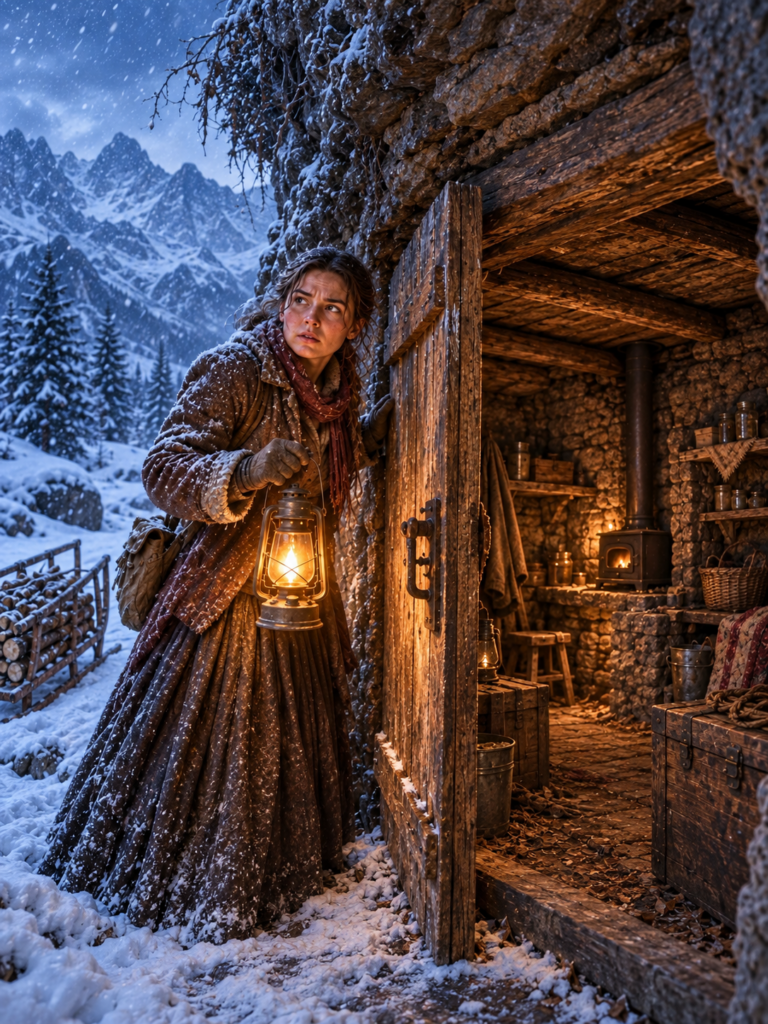
no one thought the lonely homesteader would survive the winter—until a buried door in the frozen hillside changed everything
Part 1
By the last week of November 1888, nearly everyone in Harrow Creek had already decided how Jessa’s story would end.
They did not say it cruelly, at least not when she was close enough to hear.
They said it the way rural people sometimes spoke about a horse with a bad leg or a crop planted too late.
Matter-of-fact.
Regretful.
Certain.
“She won’t make February.”
Jessa heard the words anyway.
She was twenty-seven years old, alone, and stubborn enough to file a claim on North Fork, one of the most exposed pieces of ground above Harrow Creek. The cabin leaned slightly east. The barn was little more than a shed. There was no creek close enough to be useful in winter, no thick stand of timber around the house, and nothing between the northwest wind and her front wall but miles of open country.
Men with stronger backs and larger families had refused the parcel.
Jessa had taken it because it was the only land she could afford.
Her father, Warren, had died before spring.
Until then, the two of them had worked side by side in his wheelwright shop. Warren could look at a wagon wheel rolling crooked along Main Street and tell which spoke was failing before the wagon stopped. He taught Jessa how to listen to wood, how to read grain, how to measure twice when tired and three times when frightened.
Most of all, he taught her not to confuse confidence with truth.
“Wood doesn’t care what you hope,” he used to tell her. “Measure what’s there.”
After his death, the shop did not last three months.
There were notes Jessa had never seen, lumber bills Warren had postponed, money owed on equipment, and two customers who disappeared without paying what they owed.
By midsummer, the shop belonged to somebody else.
So did the house behind it.
When Jessa finally walked away, everything she owned fit inside a wagon except Bracken, her old bay mare, who walked beside it.
The one thing Jessa carried inside her coat was Warren’s brass-hinged folding rule.
Land clerk Orin Bell had looked at her strangely when she asked about North Fork.
“You understand why it’s cheap?”
“Yes.”
“The wind hits it straight.”
“I know.”
“The cabin needs work.”
“I saw it.”
“No natural windbreak. Long haul for supplies. You get a bad December and that road disappears.”
Jessa had opened Warren’s rule on his desk, measured the blank line where her signature belonged, folded it again, and signed.
Orin leaned back.
“Why that parcel?”
Because she could not bear sleeping in rooms where every wall reminded her that her father was dead.
Because people in town lowered their voices when she entered.
Because the new owner of Warren’s shop had already painted over his name.
Because North Fork was empty.
Instead she said, “Because it’s mine if I can hold it.”
Orin had not tried to stop her again.
She moved in during September.
By October she had patched the roof, reset part of the stove pipe, chinked the worst cracks, repaired the lean-to for Bracken, and started cutting wood.
The wood worried her.
By the first week of November, it frightened her.
An early cold snap settled over the ridge. The northwest wind struck the cabin broadside and squeezed through gaps Jessa had thought she had sealed.
Each night the stove devoured more fuel.
Seven splits.
Sometimes eight.
On the worst nights, nine.
She kept a tally.
She measured the woodpile with Warren’s folding rule until she could no longer pretend.
Two and three-quarter cords, roughly.
Maybe a little more if she burned every crooked piece.
Men in Harrow Creek had warned her that North Fork might require four and a half cords before spring.
Possibly five.
One night Jessa sat at the table with her mittens still on and stared at the figures she had scratched on brown wrapping paper.
Outside, wind drove snow against the wall like handfuls of sand.
The cabin was hot near the stove.
Five feet away, her breath showed.
Her enamel cup near the east wall had begun freezing around the rim.
Jessa pressed her palms over her eyes.
For several minutes, she allowed herself something she had refused since Warren died.
Fear.
Not the dramatic kind.
There was no screaming.
No tears.
Just arithmetic.
The wood would run out.
That was all.
In the morning, she harnessed herself to a handsled and walked uphill toward the lodgepole timber.
For nearly three hours she searched for deadfall.
She found branches, one twisted section of pine, and two short logs light enough to drag.
It was almost nothing.
By late afternoon the sun had begun dropping behind the ridge.
Jessa climbed toward a granite bluff she had passed before and raised her hatchet toward a dead limb.
Then she stopped.
The snow below the rock looked wrong.
Everywhere else, the surface was wind-polished and hard.
Here, an oval patch had settled.
The snow was thinner.
Brown grass showed through.
Jessa stared.
A faint thread of vapor seemed to rise from the ground.
She crouched.
She pulled off one glove and held her hand above the snow.
Not warm.
But different.
She brushed away loose snow.
Then dead grass.
Then juniper roots.
Her fingers struck something straight.
Wood.
She dug faster.
A gray edge appeared beneath the dirt.
Jessa sat back on her heels.
“This isn’t a root.”
She cleared another foot.
Then another.
A low timber door emerged from the hillside.
At its center was a rusted iron latch.
For several seconds she simply stared.
The country above North Fork had been surveyed, grazed, crossed, abandoned, and claimed more than once.
Yet nobody in Harrow Creek had mentioned a building beneath the granite bluff.
Jessa touched the latch.
It barely moved.
She should have gone home.
Darkness was coming.
Instead, she remembered Warren.
Measure what’s there.
She loosened frozen soil from the threshold with the narrow edge of her hatchet. She cleared the hinge side. She tested the door.
It opened inward with a long wooden groan.
Dry air touched her face.
Not warm.
But still.
That alone seemed impossible.
Outside, wind moved across the ridge.
Inside, nothing moved.
Jessa lit her lamp and ducked through the opening.
The chamber was perhaps twelve feet wide and seventeen feet deep. Its floor sat several feet below ground level. Fieldstone lined the lower walls. Earth continued above them. Lodgepole beams crossed the ceiling beneath split poles, brush, and packed dirt.
Near one wall stood a stone bench.
Beside the entrance was a small firebox.
Jessa raised her lamp.
The flue did not go upward.
It disappeared beneath the bench.
Her heart began beating faster.
At the rear of the room stood a shelf.
On it were three old containers.
A wooden box.
A dented tin-lined ration box.
A crock covered with waxed cloth.
She opened the wooden one first.
Moldy hardtack.
Rodent damage.
Nothing worth trusting.
The tin-lined box was better.
Beans.
Salt.
Dry.
The crock contained strips of dried meat. Some had spoiled, but the lower pieces looked untouched by moisture.
It was not treasure.
It was barely food.
Yet Jessa understood what she was seeing.
Somebody had expected to survive here.
On the stone beneath the shelf were burned tally marks.
Beside them were two sets of initials.
E.P.
H.D.
Jessa touched one mark.
“Who were you?”
No answer came.
Then she noticed a narrow opening close to the floor.
She pulled a loose strand of wool from her coat and held it there.
The thread moved inward.
Air.
Across the chamber, a higher passage disappeared behind the granite shoulder.
She brought her lamp toward it.
The flame leaned outward.
Low air entered.
High air left.
Jessa looked back at the stone bench.
Then at the firebox.
Then at the door.
Night was gathering outside.
She could not safely test anything now.
So she measured.
Firebox.
Bench.
Air intake.
Floor depth.
Door.
She wrote every figure in the small notebook she kept inside her coat.
Then she looked again at the food.
She took nothing.
Before leaving, Jessa placed her hand on Warren’s folding rule.
For the first time in weeks, the numbers in front of her did not feel like a sentence.
They felt like a question.
She closed the underground door and started home.
That night, North Fork shook beneath the wind.
Jessa fed eight pieces of wood into the stove before dawn.
At sunrise, she measured her shrinking fuel stack.
Then she closed the rule.
“All right,” she whispered.
“If you’re going to save me, prove it.”
And before breakfast, Jessa packed her tools and started back toward the hidden door in the hill.
Part 2
Jessa trusted evidence more than hope.
Hope had not kept Warren alive.
Hope had not saved the wheelwright shop.
Hope had not stopped creditors from carrying away tools her father had used for twenty years.
So she did not move into the hidden shelter.
Not yet.
She tested it.
The first problem was the flue.
Jessa spent almost two hours pulling debris from the masonry passage beneath the stone bench. Pine needles came first. Then pieces of bark. Then part of an old nest.
Finally she drew out black clumps of soot.
Outside, behind the granite shoulder, she located the chimney outlet.
A slab of shale had fallen partly across it.
Jessa considered moving it.
Then stopped.
She did not know enough yet.
Back inside, she placed dry grass in the firebox and struck a flame.
Smoke disappeared into the channel.
She waited.
Nothing returned.
She added one pine split.
Then another.
The fire burned steadily.
Jessa sat on an overturned box with her coat buttoned to the neck.
For twenty minutes she felt almost foolish.
The space did not grow dramatically warmer.
The earth walls remained cool.
The far end of the chamber barely changed.
“So much for miracles.”
Then the fire began dying.
Jessa reached toward the stone bench.
She froze.
Warm.
Not hot.
Warm.
She waited another fifteen minutes.
The heat had traveled farther down the masonry.
The old builders had created something Jessa had seen only in crude descriptions: instead of sending hot smoke directly outside, they had routed it through stone, allowing the masonry to absorb heat before the gases escaped.
She placed a cup of water near the rear wall.
Then she left.
The next morning, frost covered North Fork.
At the cabin, her wash water had frozen.
At the shelter, the firebox was cold.
Jessa touched the bench.
Warmth remained.
She stared.
Then hurried toward the cup.
Liquid.
She picked it up and laughed.
The sound startled her.
She had not heard herself laugh since before Warren’s funeral.
“You clever old fools.”
Her smile disappeared when she noticed a black mark above the firebox.
Fresh soot.
Jessa touched it.
Black came away on her fingertip.
She immediately opened the door.
The shelter worked.
That did not mean it was safe.
She lit another small test fire.
At first the draft behaved perfectly.
Then a strong northwest gust struck the bluff.
Smoke hesitated.
For one second, a ribbon pushed backward.
Jessa extinguished the fire.
Outside she climbed toward the chimney.
The fallen shale was angled like a scoop toward the wind.
She finally understood.
The outlet itself had likely once been protected by the granite shoulder. The fallen slab had changed the airflow and forced pressure downward into the flue.
Jessa tied wool threads near the stone and waited through several gusts.
Two streamed sideways.
The lowest snapped downward.
There.
She moved only the loose shale.
Beneath it she found impressions suggesting stones had once formed a low protective lip.
Jessa rebuilt it.
Then she tested again.
The wind rose.
The flame trembled.
Smoke continued outward.
She waited three hours.
No backdraft.
The next day she repeated the test.
Then again.
Only after three successful burns did she trust it.
That evening, sitting alone at her cabin table, she looked at Warren’s photograph.
It had been taken years earlier. He was standing outside the wheelwright shop with one hand resting on a wagon wheel taller than Jessa had been at the time.
“You’d tell me I’m being too careful.”
She studied his face.
“No. You wouldn’t.”
Warren had survived long enough to know that carelessness often wore the same clothes as courage.
The next morning Jessa began moving supplies underground.
Blankets.
Flour.
Coffee.
Dried apples.
Beans.
Lamp oil.
Tools.
A portion of her firewood.
She left the old provisions separate.
Whatever had remained there for decades would be emergency food only.
Bracken could not live underground.
That worried Jessa more than anything.
The old mare had belonged to Warren. She was not fast and had never been pretty, but she was patient, steady, and intelligent enough to refuse bad footing before a rider noticed it.
Jessa strengthened the lean-to below the claim and packed its windward side with boards.
Every morning and evening, regardless of weather, she walked down to check Bracken.
Her first full night in the underground shelter felt unnatural.
There was no wind against the walls.
No roof rattle.
No stove ticking violently as it expanded.
Silence pressed around her.
Jessa burned three short splits.
Then she let the fire die.
At two in the morning she woke.
For a moment she forgot where she was.
Then she placed her hand on the stone bench.
Warm.
Her water had not frozen.
She counted the unused wood.
Three splits remained from the small stack she had brought inside.
At the cabin, a night like this would have taken seven or eight.
Sometimes nine.
Jessa opened her ledger.
For weeks, every calculation had shortened her future.
That night the numbers finally moved in the other direction.
She sat looking at them for a long time.
Then tears came.
Quietly.
Not because she was saved.
Winter had months left.
She cried because, for the first time since Warren died, something had gone right.
Jessa covered her mouth with one hand.
“I’m trying, Papa.”
The words disappeared into the earth.
Three days later, the shelter reminded her that survival never solved only one problem.
Snow had fallen overnight.
When Jessa swept the dirt floor, she noticed fine dust beneath one of the roof members.
She looked up.
One lodgepole beam seemed slightly twisted.
Most people would have ignored it.
Jessa opened Warren’s rule.
She measured from the floor to the underside of the sill.
Then she marked the height with pencil.
The next morning she measured again.
The roof had dropped approximately one-eighth of an inch.
After another snowfall, nearly a quarter.
Jessa’s stomach tightened.
Outside, she dug carefully along the downhill edge until she found the problem.
The timber was not badly rotten.
The stone supporting one end had settled.
Years of water, freezing, thawing, and soil movement had gradually undermined it.
Now snow above the buried chamber was loading the weakened point.
Jessa went inside.
She moved her cot.
Then the flour.
Then the lamp oil.
She did not sleep beneath the sagging section.
That night the bench stayed warm.
The shelter remained comfortable.
Jessa measured the beam before bed.
The mark had changed again.
She stared at Warren’s rule.
Warmth could save her from freezing.
It could not hold up a roof.
At dawn she took her axe and handsled east toward a drainage where she had seen standing dead lodgepole.
She found a straight trunk about five and a half inches thick.
Cutting it took most of the morning.
Dragging the pieces uphill took longer.
Twice Jessa slipped.
Once she remained sitting in the snow for nearly a minute because her legs had begun trembling.
Nobody would have blamed her for returning home.
Nobody was watching.
That was precisely why she stood up.
By afternoon she had hauled enough timber to build a vertical shore, short cap, and angled brace.
She placed flat shale on firm ground.
Set the shore.
Fitted the cap.
Then carefully drove a wooden wedge beneath the weak section.
One strike.
Pause.
Another.
The beam lifted slightly.
Jessa stopped.
She added the angled brace.
Then measured.
The next morning she measured again.
No change.
Twenty-four hours later, still no change.
Forty-eight hours.
Stable.
Jessa ran her finger across the old pencil marks.
They remained visible.
She intentionally left them.
Mistakes and danger should not disappear simply because they had been corrected.
That same afternoon, smoke from her hidden chimney caught the attention of Amos Reddick.
Amos was a stockman in his early fifties who ran cattle several miles from North Fork.
He climbed the ridge expecting to find some desperate makeshift dugout.
Instead he found Jessa opening a timber door in the hillside.
Amos removed his hat.
“What in God’s name is this?”
“Still deciding.”
He ducked through the entrance.
His eyes adjusted slowly.
The heater had been cold for most of the day.
He touched the bench.
Then touched it again.
“That fire burning somewhere?”
“Hasn’t burned since morning.”
Amos looked at her sharply.
He checked the water crock.
Liquid.
Then the roof supports.
Then the black soot crescent Jessa had deliberately left above the firebox.
“What happened there?”
“Backdraft.”
“You still slept in here?”
“Not until I fixed it.”
She explained the shale and the northwest wind.
Amos listened without interrupting.
When she finished, he nodded toward the door.
“You know what happens when a real storm drifts against this slope?”
“Snow piles there.”
“It could bury that entrance.”
“I know.”
“You’ve got one way out.”
Jessa’s jaw tightened.
Amos pointed toward the intake.
“And runoff crosses below that opening. Freeze it shut and you lose air.”
Jessa wanted to tell him that she had already solved more problems than anyone in town thought she could.
Instead she followed his gaze.
The drift line was obvious.
So was the shallow runoff trace.
Amos pulled his gloves back on.
“Warm place,” he said. “Could still kill you.”
After he disappeared downhill, Jessa stood outside alone.
Her pride wanted to dismiss him.
Her father’s voice said something else.
Measure what’s there.
Jessa fetched a shovel.
She dug a recessed space inside the doorway where the tool could remain accessible if snow blocked the entrance.
She drove a tall marker pole into the slope above the door.
She cleared the drainage near the intake.
She sorted wood by size.
She carried extra water.
Then she descended to Bracken’s lean-to and reinforced another section.
The mare watched her work.
“You and me,” Jessa said.
Bracken chewed hay.
“That’s what’s left.”
By the following morning, the sky had changed.
Smoke flattened instead of rising.
The mare stood with her hindquarters toward the northwest.
Harness grease had stiffened.
High cloud spread across the mountains.
At noon, the wind stopped completely.
The silence unsettled Jessa more than any gale.
Later, Lyle Mercer came along the freight road.
He slowed his wagon.
“Road crew turned around.”
Jessa looked toward the mountains.
“How bad?”
“Hard front coming down.”
“When?”
Lyle glanced at the sky.
“Soon.”
Jessa nodded.
Lyle frowned.
“You staying up here?”
“Yes.”
“That cabin won’t hold heat.”
“I’m not staying in the cabin.”
He looked confused.
Jessa did not explain.
By late afternoon, every pine on North Ridge stood absolutely still.
Then the temperature dropped.
One long gust came over the mountain.
Snow lifted from the ground.
Jessa looked toward the hidden shelter.
The storm had arrived.
And this time, there would be no second test.
Part 3
The first hours went exactly as Jessa had prepared for.
That frightened her.
Real disasters often began by behaving.
She checked Bracken.
Filled the mare’s water.
Added hay.
Secured the lean-to.
Then climbed through increasingly heavy snow toward the hidden shelter.
Inside, Jessa lit three dry splits.
The heater drew cleanly.
Within an hour the stone near the firebox began taking warmth.
Outside, the northwest wind became a continuous roar.
Snow struck the ridge, lifted again, and packed against every obstruction.
Jessa checked the doorway before dark.
Half the marker pole remained visible.
Later, less.
Near midnight she pushed the door.
It opened only several inches.
Snow had already packed against it.
Her pulse quickened.
Then she remembered the recessed shovel.
Jessa knelt, pulled it free, and began cutting snow away from the threshold from inside.
Small sections collapsed into the chamber.
She shoveled them backward.
Again.
Again.
Finally the door moved enough.
Air entered.
Jessa closed it.
“Good.”
Her voice sounded strange underground.
Behind her, the fire had fallen to embers.
Heat continued radiating from the bench.
She sat on the cot and listened.
Wind overhead.
Occasional ticking from the heater.
Then—
Click.
Jessa raised her head.
Dust drifted through the lamplight.
Click.
She stood.
Another roof member had moved.
Not the one she had repaired.
A different one.
Jessa lifted the lamp.
The timber itself had not split.
But one end had shifted perhaps half an inch.
The new snow above the chamber was creating uneven pressure.
Jessa felt cold despite the heat.
Outside was impossible.
The storm would knock her down before she reached the roofline.
She looked toward the rear wall.
The unused section of lodgepole from her earlier repair remained there.
She dragged it beneath the weak point.
Too short.
Jessa shut her eyes.
For half a second, despair hit hard.
She could see Warren’s shop.
The creditors.
The empty walls.
Her wagon leaving town.
Men saying North Fork would break her.
Maybe they had simply been right.
Another faint groan came from the roof.
Jessa opened her eyes.
“No.”
She stacked broad pieces of shale on firm ground to create a higher footing.
Then she raised the lodgepole.
Still slightly short.
She fitted a wooden cap above it.
Then a wedge.
One strike.
She stopped.
Listened.
Another strike.
The roof groaned long and low.
Jessa froze with the mallet raised.
Nothing fell.
She waited.
Measured.
Waited five minutes.
Measured again.
No movement.
She exhaled.
Then noticed the lamp.
The flame was behaving differently.
The draft had weakened.
Jessa crouched near the intake.
Frost had formed inside the channel.
Blowing snow and extreme cold were narrowing the passage.
She looked toward the woodpile.
Her first instinct was to add fuel.
Then she stopped.
A larger fire with a failing draft could fill the shelter with smoke.
Perhaps worse.
Jessa placed the split back on the stack.
She cleared the intake first.
Slowly.
Carefully.
Ice came loose.
The lamp flame leaned again.
Air moved.
Only then did she feed the heater.
Somewhere in the darkness beyond the earth walls, the wind screamed across North Fork.
Jessa sat on the cot.
She wanted her father.
Not his tools.
Not his rules.
Him.
“Papa.”
Her voice broke.
She remembered being nine years old and falling asleep beneath the workbench while Warren finished a wagon hub after midnight.
She remembered him carrying her home.
At twelve, he let her measure spokes.
At sixteen, he taught her to use a drawknife.
At twenty-three, he began complaining that she worked too much.
“You’ll wake up one morning and find thirty years went somewhere without asking permission.”
She had laughed.
Now she understood.
Jessa took out Warren’s folding rule.
Its brass hinges reflected the lamplight.
She ran her thumb over his initials.
Then folded it closed.
“You taught me enough.”
The storm lasted through the night.
Then another day.
Then another.
Time became a cycle.
Clear intake.
Check roof.
Count wood.
Check water.
Eat.
Rest.
Check Bracken when the weather permitted.
Return.
Measure.
Listen.
The temperature fell so severely that touching the iron latch hurt through her glove.
Frost returned to the intake faster each hour.
Above ground, the old cabin took the storm directly.
Inside the earth, the walls did not shake.
Jessa fired the heater in small measured loads.
Three splits.
Then two.
She allowed the stone to release stored heat for hours.
She recorded every firing.
On the second day, she realized something astonishing.
Her woodpile was shrinking slowly.
Far more slowly than it had inside the cabin.
The old shelter was not comfortable in the way wealthy people might understand comfort.
There were no carpets.
No upholstered chairs.
No windows.
No stove glowing cheerfully in a parlor.
But the water remained liquid.
Her fingers remained useful.
She could sleep without fearing she would wake unable to move.
That was enough.
During a lull, Jessa fought her way to Bracken.
The mare stood under the reinforced lean-to with frost coating her whiskers.
“Hey, old girl.”
Bracken turned.
Jessa pressed her forehead against the mare’s face.
“You’re all right.”
For several seconds she stood there.
The animal smelled of hay, cold leather, and the familiar stable scent that had filled Warren’s yard for years.
Jessa almost cried again.
Instead she broke ice from the water container and checked Bracken’s legs.
Then she returned to the shelter.
By the third day, her appetite had become difficult to ignore.
She opened the emergency box.
Some of the old hardtack remained usable after the damaged pieces were discarded.
She added a small portion to her meal.
Then cooked a few of the stored beans with her own.
The forgotten provisions did not save her from starvation.
She had brought food.
But they stretched what she had.
One meal.
Then another.
Margin.
That word had ruled her winter.
Margin between warmth and freezing.
Between enough wood and none.
Between a stable roof and collapse.
Between courage and foolishness.
At the rear shelf, Jessa looked again at the old burned tally marks.
E.P.
H.D.
Whoever they were, they had counted too.
Fuel perhaps.
Meals.
Days.
Nobody would ever know.
Jessa sharpened her pencil.
Beside their marks, without covering them, she added her own.
On the fourth morning, the wind weakened.
Jessa pushed against the door.
Nothing.
She tried again.
Packed snow held it shut.
Her heart began pounding.
She forced herself to stop.
Panic wasted air and strength.
She pulled the shovel from its recess.
Then began digging upward from inside.
Ten minutes.
Twenty.
Forty.
Sweat formed beneath her coat.
She removed her hat.
An hour passed.
Then the shovel suddenly broke through.
A blade of white light entered.
Cold air followed.
Jessa laughed.
She dug wider.
When she finally crawled outside, North Fork had changed shape.
Drifts swallowed fence lines.
Part of the woodshed roof had collapsed.
The cabin chimney cap sat crooked.
The side door was buried.
Across the basin, a livestock shelter had lost part of its roof.
Jessa looked back at the small opening in the hillside.
The hidden shelter remained.
So did she.
Her first thought was not triumph.
“Bracken.”
She climbed down.
The mare was standing.
Hungry.
Cold.
Alive.
Jessa wrapped both arms around her neck.
“You stubborn old thing.”
Bracken breathed against her shoulder.
Later that afternoon Amos Reddick appeared on snowshoes.
He approached the hidden door without saying much.
Inside, he removed one glove and touched the bench.
Then the water crock.
Then the roof braces.
His eyes went to the remaining wood.
“How much did you burn?”
Jessa handed him the tally.
Amos read it.
Then read it again.
Finally he looked toward the door.
“My place burned almost twice that.”
Jessa said nothing.
He studied the soot crescent above the firebox.
“You left that mark.”
“Yes.”
“Why?”
“To remember what failed.”
Amos nodded slowly.
Outside, wind damage covered the basin.
Inside, Jessa’s water remained liquid and her fuel remained stacked.
Amos put his glove back on.
“I was wrong about one thing.”
Jessa looked at him.
“I thought this place was just an old hole somebody dug because they couldn’t afford better.”
“And now?”
Amos glanced along the stone bench.
“Now I think somebody knew something we forgot.”
After he left, Jessa sat alone.
For weeks she had imagined how it might feel when one of Harrow Creek’s men admitted she had done something right.
She had expected satisfaction.
Instead she felt tired.
Deeply tired.
She did not need an apology.
The storm had given her something more useful.
Proof.
Part 4
News traveled slowly after the storm because the roads had nearly vanished.
But it traveled.
A woman had survived North Fork.
Not merely endured it.
Survived with wood left over.
That detail bothered people.
The first visitor after Amos was Mabel Crowder.
Mabel ran the dry goods counter and had been among those who said the claim would break a healthy man.
She entered the shelter bent almost double beneath the low doorway.
Her eyes moved over everything.
The bench.
The heater.
The air channel.
Roof supports.
Fuel stack.
Finally the soot crescent.
“How long does that stone stay warm?”
Jessa hid a smile.
“Depends how hard I fire it.”
“Hours?”
“Yes.”
Mabel touched the bench.
“So the fire goes out?”
“Yes.”
“And this stays warm?”
“Yes.”
Mabel looked irritated, as though Jessa had broken a law of nature.
“Why didn’t anybody know this was here?”
“I didn’t.”
“Who built it?”
Jessa pointed toward the old initials.
“No idea.”
Mabel stood looking at them.
When she left, she did not apologize for anything she had said.
Jessa did not ask her to.
Lyle Mercer came two days later.
Freight camps consumed enormous amounts of wood, and he was interested in one thing.
“How?”
Jessa showed him the route of the flue.
Lyle crouched beside the bench.
“So I make one of these at camp, I cut my wood in half?”
“No.”
He looked disappointed.
“Why not?”
“Because it isn’t only the bench.”
She pointed.
“Earth blocks the wind. Stone stores heat. Intake feeds combustion. Outlet has to draft correctly. Snow can bury the door. Frost can choke the intake. Roof loads change.”
Lyle frowned.
“I thought you found some secret.”
“There isn’t one.”
She looked around.
“It works because everything works together.”
That answer spread too.
Some people liked it less.
Secrets were simple.
Systems required work.
Winter continued.
December became January.
Jessa gradually improved the shelter without pretending it was permanent.
She added a second shovel.
Built a better rack for fuel.
Marked the intake location outside.
Inspected the roof after every significant snowfall.
Bracken remained below in the lean-to.
Twice Jessa slept beside the mare during calmer nights when the temperature permitted it, simply because she missed hearing another living creature breathe.
One evening Netty Voss arrived.
Netty had once slipped extra candles into Jessa’s supply sack without saying anything.
Now she carried a covered pot.
“You’re thin.”
“So are you.”
“I run a boarding house. I’m allowed.”
Jessa lifted the cloth.
Chicken stew.
She looked up.
“Netty.”
“Don’t start thanking me. Amos brought beef into town and Mrs. Halpern gave me potatoes.”
Jessa stepped aside.
“You want to see it?”
Netty entered.
Unlike the others, she did not immediately inspect the engineering.
Her attention went to Jessa’s cot.
Then Warren’s photograph.
Then the folding rule.
“You brought him with you.”
Jessa looked at the photograph.
“In a way.”
They ate stew beside the warm stone bench.
Netty listened while Jessa described finding the door.
Eventually she said, “Your father would’ve bragged so hard people would’ve stopped inviting him places.”
Jessa laughed.
“He hated bragging.”
“About himself.”
That silenced her.
Netty set down her spoon.
“Jessa, you know surviving something doesn’t mean you have to keep proving you can do everything alone.”
The words landed harder than Jessa expected.
She stared into the bowl.
“I didn’t choose alone.”
“No.”
Netty’s voice softened.
“But sometimes after enough people leave, you start treating loneliness like a promise.”
Jessa looked toward the door.
Warren had died.
Creditors had taken the shop.
Neighbors had expected North Fork to defeat her.
She had answered by making herself need nobody.
It had kept her moving.
Maybe it had also become another kind of prison.
“I don’t know how to do it differently,” Jessa admitted.
Netty reached across the small table.
“You don’t have to know yet.”
After she left, Jessa sat beside the heater for a long time.
The winter had begun as a struggle against cold.
But North Fork was changing something else.
People came now.
Not to watch her fail.
To learn.
Amos returned carrying paper and a carpenter’s pencil.
“I want to build something smaller near my calving shed.”
Jessa examined his sketch.
“A warming room?”
“For bad nights.”
“Your outlet’s wrong.”
“I knew you’d say that.”
“Then why draw it wrong?”
“To see if you actually understood yours.”
Jessa stared at him.
Amos grinned.
For the first time, she grinned back.
They spent two hours adjusting the sketch.
When it came time to measure the bench, Jessa reached automatically into her coat.
Her hand closed around Warren’s folding rule.
She paused.
Since his death, nobody else had touched it.
Not Orin.
Not Netty.
Nobody.
Amos waited.
Jessa opened her hand.
Then held out the rule.
“Seven feet, roughly. Measure it yourself.”
Amos accepted it carefully.
He unfolded the brass hinges.
Jessa watched her father’s tool stretch across the stone.
Something in her chest loosened.
That rule had measured the last lumber in Warren’s shop.
It had measured her shrinking woodpile.
It had measured a settling roof that might have killed her.
Now somebody else was using it to build something.
Not preserve the past.
Continue it.
But North Fork was not finished with her.
In late January, a thaw struck unexpectedly.
For almost two days temperatures climbed.
Snow softened.
Water began moving beneath the surface.
Jessa checked the intake repeatedly.
On the second afternoon she noticed damp soil along one wall.
By evening it had become a thin seep.
Her stomach tightened.
The shelter’s strength was also its weakness.
It lived inside the earth.
If runoff saturated the wrong section, water could undermine the stone bearings supporting the roof.
Jessa climbed outside.
The snowpack above the chamber had begun releasing meltwater toward the granite bluff.
The original builders had shaped shallow drainage channels, but decades had filled parts of them.
Jessa grabbed a shovel.
For hours she redirected water away from the roofline.
Mud soaked her skirt.
Her gloves became useless.
At dusk Amos arrived unexpectedly.
He took one look.
“Inside.”
“I need another ditch along that side.”
“I’ll do it.”
“I know where—”
“Show me.”
Jessa stopped.
Two months earlier she would have argued.
Instead she pointed.
“Keep it shallow. Don’t cut into the bank.”
Amos worked outside while Jessa inspected the interior bearings.
Later Netty sent two men from the boarding house with extra boards.
Lyle arrived with a wagonload of flat stone once the road cleared enough.
Nobody had been summoned formally.
They came because someone had told someone.
By midnight, the seep had slowed.
Jessa sat exhausted beside the heater.
Amos dropped onto an upturned crate.
“You know,” he said, “this is considerably easier with more than one fool.”
Jessa laughed weakly.
“I noticed.”
The thaw passed.
The shelter held.
Then February arrived.
Jessa had enough wood.
That fact no longer seemed miraculous.
She had enough food too, though supplies were plain.
Bracken remained healthy.
The cabin still needed serious repair.
North Fork was still isolated.
She was not suddenly wealthy.
Yet something had changed in Harrow Creek.
When she entered the dry goods store, conversations no longer stopped.
People asked questions.
One ranch wife wanted advice about banking earth against a chicken house.
A freight worker asked about masonry.
Orin Bell, the land clerk who had warned her away from North Fork, requested to see the shelter.
He stood inside almost speechless.
Finally he said, “This wasn’t on the survey record.”
“I assumed not.”
“There may be older territorial notes.”
“Can you find them?”
“I can look.”
Two weeks later Orin returned carrying a folded packet.
“I found something.”
Jessa opened it.
The documents were old and incomplete, but one notation referred to a winter station near the granite shoulder above North Fork.
Two names appeared.
Elias Porter.
Henry Danner.
E.P.
H.D.
Jessa stared.
According to the record, the men had maintained a temporary winter station decades earlier for freight traffic before the road shifted south.
There was no grand mystery.
No hidden fortune.
No outlaw gold.
Just two men who had once faced the same cold and solved it with stone, earth, airflow, and patience.
Jessa liked that better.
“They built it to survive.”
Orin nodded.
“Looks that way.”
She touched the paper.
“Do these records say what happened to them?”
“Porter moved west. Danner may have died in the territory. Nothing certain.”
Jessa looked at the tally marks.
People passed through the world.
Their work sometimes stayed.
That night she placed the copy of their names beside Warren’s photograph.
Three men gone.
Three sets of knowledge remaining.
Jessa sat alone beside the warm bench.
Outside, snow began falling softly.
For the first time since Warren died, the silence around her did not feel empty.
It felt inhabited by memory.
And when she opened her ledger, she discovered she had enough fuel to reach spring with a margin greater than she had dared imagine.
Part 5
Spring did not arrive dramatically.
There was no morning when North Fork suddenly turned green.
Winter retreated reluctantly.
Snow shrank first along south-facing rock.
Then dark earth appeared near fence posts.
The road softened into mud.
Bracken began shedding clumps of winter hair.
One afternoon, water ran openly along the lower drainage.
Jessa stood outside the hidden shelter with her coat unbuttoned.
She listened.
Dripping water.
A distant bird.
Bracken moving below.
No screaming wind.
She almost did not recognize the quiet.
Inside the shelter, the final fuel tally remained written beside the old marks of Elias Porter and Henry Danner.
Wood still stood stacked near the heater.
Three dry splits lay on top.
Jessa picked one up.
Turned it in her hands.
Then set it down.
She did not need to burn it.
That mattered more than anyone else would understand.
When Jessa had first arrived at North Fork, people believed winter would decide whether she belonged.
She had believed it too.
Now she understood differently.
The land had never asked whether she deserved it.
The land had simply presented conditions.
Wind.
Cold.
Distance.
Water.
Weight.
Wood.
Human beings were the ones who turned hardship into judgment.
By April, Harrow Creek began rebuilding what winter had damaged.
Amos constructed a small earthen warming room beside his calving barn.
He did not copy Jessa’s shelter exactly.
She would not let him.
“Different ground,” she reminded him.
“Different wind.”
He nodded.
“Different drainage.”
“Exactly.”
Lyle experimented with a stone heat bench at one freight stop.
Mabel Crowder convinced her brother to bank earth against the windward side of his root cellar.
People stopped calling the hidden room Jessa’s hole.
They started calling it the North Fork shelter.
One Saturday, several families came to see it.
Children crowded around the low doorway until Jessa ordered them away from the heater.
An old rancher named Silas touched one roof brace.
“You put this in?”
“Yes.”
“By yourself?”
“The first one.”
He looked at the second brace.
“And that?”
“During the storm.”
Silas stared at her for several seconds.
Then said, “Warren taught you well.”
Jessa swallowed.
“Yes.”
“He fixed a wheel for me once. Wouldn’t take full payment because I’d lost cattle that year.”
Jessa had never heard that story.
Others followed.
A widow remembered Warren replacing a broken chair rung.
Lyle remembered him repairing a wagon for a family heading west.
Netty remembered Warren bringing firewood to her boarding house during a winter when three guests had vanished without paying.
Jessa listened.
All year she had thought grief meant Warren was disappearing.
The shop was gone.
His house was gone.
His tools had scattered.
His voice existed only in memory.
Yet piece by piece, people returned parts of him to her.
Not possessions.
Evidence.
Evidence that a life continued inside other lives.
Weeks later Orin Bell rode up carrying another document.
Jessa met him outside the cabin, which she had begun repairing for spring use.
“I need your signature.”
Her heart immediately tightened.
“What happened?”
“Nothing bad.”
He handed her the paper.
“The county wants the shelter noted on the property survey. Historical structure.”
Jessa read carefully.
Ownership remained with the North Fork claim.
No seizure.
No restriction preventing her from using it.
Orin watched her.
“You really do read everything.”
“My father taught me.”
“Good habit.”
She signed.
Then Orin cleared his throat.
“There’s something else.”
Jessa looked up.
“People in town want to make a winter preparedness committee.”
She nearly laughed.
“A what?”
“After what happened.”
“People have survived winters here before.”
“Yes.”
“Long before me.”
“Yes.”
“So why me?”
Orin looked toward the ridge.
“Because you kept records.”
Jessa said nothing.
“You didn’t tell everyone you had some miracle. You documented the failures too. Amos says that soot mark is still on the firebox.”
“It is.”
“He says you left it intentionally.”
“I did.”
Orin nodded.
“That’s why.”
Jessa thought of Warren.
Measure what’s there.
“Who else?”
“Amos. Lyle. Netty volunteered before anybody asked. Silas probably.”
“That sounds dangerous.”
Orin smiled.
“Probably.”
Jessa agreed.
Not because she wanted recognition.
Because next winter another person might misjudge a chimney.
Another roof might settle.
Another isolated family might burn wood too quickly.
Knowledge was most valuable before somebody desperately needed it.
By May, the old cabin had become livable again.
Jessa repaired the chimney cap.
Rebuilt part of the woodshed.
Improved the chinking.
She did not abandon the underground shelter.
Instead she treated it as what it was.
A winter refuge.
A piece of inherited wisdom.
One afternoon Netty visited while Jessa was replacing fence rails.
“You staying?”
Jessa looked around.
North Fork stretched green beneath the spring light.
Bracken grazed nearby.
The granite bluff rose above the claim.
“Seems foolish to do all that surviving just to leave.”
Netty smiled.
“That wasn’t what I meant.”
Jessa stopped working.
Netty leaned against the fence.
“You planning on staying alone forever?”
Jessa groaned.
“Oh, Lord.”
“I’m only asking.”
“No, you’re not.”
“I run a boarding house. Asking questions is half my business.”
Jessa returned to the fence.
“I don’t know.”
“That’s a better answer than no.”
“Go home, Netty.”
Netty laughed all the way to her wagon.
Life did not become perfect.
That would have insulted everything Jessa had learned.
There were still bills.
Still fence posts.
Still livestock feed to buy.
Still days when Warren’s absence opened suddenly inside her.
Sometimes she entered the old cabin expecting to hear him complain about a tool being left wet.
Sometimes she woke underground and needed several seconds to remember why she was alone.
But loneliness no longer felt like the entire world.
Amos stopped by.
Netty arrived with food.
Lyle brought news from the road.
Mabel occasionally sent supplies at cost and pretended it was an accounting mistake.
People learned to knock at the hidden door.
By late summer, Jessa’s fuel preparations looked nothing like the year before.
She began cutting early.
She seasoned the wood correctly.
She kept separate stacks for cabin and shelter.
She measured every cord.
When October returned, Harrow Creek watched North Fork again.
This time nobody predicted her death.
People asked how much wood she had stored.
“Enough,” Jessa answered.
That winter was milder.
The shelter saw less use.
Still, whenever strong northwest wind came across the ridge, Jessa went underground.
She checked the draft.
Checked the roof.
Checked the intake.
Burned measured loads.
The soot crescent remained.
So did the old initials.
E.P.
H.D.
Beside them, Jessa’s tally remained visible from the storm that had nearly buried her alive.
She never erased it.
Years later, people told the North Fork story incorrectly.
Stories always changed.
Some said Jessa had discovered an underground mansion.
Others claimed there had been enough preserved food inside to last all winter.
One ridiculous version included hidden gold.
Children preferred that one.
Jessa corrected them whenever she heard it.
“There was no gold.”
“What was there, then?”
“Beans.”
Children were always disappointed.
“Old beans?”
“Very old beans.”
“That’s boring.”
Jessa would smile.
“It wasn’t boring when I was hungry.”
The truth was smaller than legend.
And more important.
The shelter had not magically saved her.
It had almost poisoned her with backdraft.
Almost trapped her behind snow.
Nearly failed beneath roof load.
Its intake had begun freezing.
Water threatened it during the thaw.
Each danger had required attention.
Work.
Humility.
The willingness to admit that something useful could still be dangerous.
That became the lesson Jessa carried into everything afterward.
Years passed.
Bracken grew slower.
One autumn morning, the mare failed to rise.
Jessa sat beside her in the lean-to for hours with one hand against her neck.
There was no dramatic struggle.
Bracken simply grew tired.
Near sunset, her breathing stopped.
Jessa buried her below the ridge where spring grass came early.
For days afterward, North Fork felt empty again.
Then Amos arrived with a young bay mare.
Jessa crossed her arms.
“No.”
“Didn’t ask you.”
“I’m not taking her.”
“She’s already here.”
“Amos.”
“Owner owed me money.”
“That sounds like your problem.”
“It became yours somewhere down the road.”
Jessa stared at him.
The mare reached toward her coat.
Jessa sighed.
“What’s her name?”
Amos smiled.
“Your problem now.”
Jessa called the mare June.
By then the winter preparedness group had become an annual gathering.
Ranchers compared fuel use.
Women shared food-storage methods.
Freight drivers discussed windbreaks.
Jessa demonstrated draft testing with a wool thread.
She always pointed to the black soot crescent.
“This,” she told newcomers, “is the most important part.”
Someone inevitably asked why.
“Because this is where I was wrong.”
The room usually went quiet.
Jessa continued.
“Knowing what works is useful. Knowing what failed may keep you alive.”
Warren would have approved.
One November afternoon, decades after Jessa first opened the hidden door, a young widow came to North Fork.
Her name was Sarah Bell.
She had two children, little money, and a farm outside Harrow Creek she was struggling to keep after her husband’s death.
Jessa was gray-haired by then.
Her hands ached in winter.
Sarah stood awkwardly at the cabin door.
“Mrs. Ward?”
“Jessa.”
“I was told you might know how to make my house use less wood.”
“Who told you?”
“Everybody.”
Jessa rolled her eyes.
“Come inside.”
Sarah unfolded a crude drawing of the farmhouse.
She talked quickly.
Too quickly.
Jessa recognized it.
Fear disguised as planning.
The woman had counted her wood.
She knew.
Jessa looked at Sarah’s measurements.
Then reached into a drawer.
Warren’s old folding rule lay inside.
The brass hinges were dark with age.
Jessa carried it outside.
Sarah followed.
They spent the afternoon examining the farmhouse.
Foundation.
Chimney.
Wind direction.
Fuel storage.
At one point Sarah apologized.
“I’m sorry. I thought you’d just tell me some trick.”
Jessa looked at her.
“There is no trick.”
Sarah’s face fell.
“There are problems,” Jessa continued. “Problems can be measured.”
She opened Warren’s rule.
“Start there.”
That winter Sarah kept her farm.
Years afterward, one of her sons would become a carpenter.
He would remember the gray-haired woman from North Fork who had shown him how to check a wall for draft with wool thread.
That was how knowledge traveled.
Not as treasure.
As practice.
Not as magic.
As attention.
On the final winter evening Jessa spent alone at North Fork, snow fell gently above the granite bluff.
She entered the shelter carrying three short splits.
Age had slowed her.
She descended carefully.
The old braces remained.
The stone bench remained.
The initials remained.
She lit the fire.
Sat down.
Then opened Warren’s folding rule across her lap.
Its numbers had faded.
One hinge had been repaired twice.
Jessa touched her father’s initials.
She no longer felt the sharp grief that once made breathing difficult.
Memory had changed.
It had become warmer.
Like the stone beneath her.
Heat stored slowly.
Released slowly.
Lasting after the flame itself disappeared.
Jessa looked toward the old tally wall.
E.P.
H.D.
Then her own marks.
Different people.
Different winters.
The same human problem.
How to leave enough behind for whoever came next.
The fire burned down.
Jessa did not add another split.
Hours later, warmth still moved gently through the bench.
Her water remained liquid.
Outside, North Fork disappeared beneath moonlit snow.
Inside, an old woman sat comfortably beneath the earth with more fuel beside her than she needed.
She lifted one unused piece of pine.
For a moment she remembered the terrified young woman who had once measured a failing woodpile and calculated how many freezing nights remained.
She wished she could speak to her.
She would not promise that everything would be easy.
It had not been.
She would not promise that everyone who doubted her would apologize.
Most never had.
She would not promise that grief disappeared.
It did not.
She would tell that frightened woman something simpler.
Keep measuring.
Keep learning.
Do not let pride stop you from listening.
Do not let loneliness convince you that help is weakness.
And when you find something that keeps you alive, leave it better for the next person.
Jessa set the split back on the pile.
Three pieces remained.
Exactly three.
She smiled.
Winter had once measured how little she had left.
Now those three unburned pieces measured something else.
Enough.
Outside, snow continued falling over North Fork.
Inside, the fire went out.
And the stone stayed warm.

